
A law firm does not want marketing. It wants signed cases. The agencies that win legal accounts and keep them are the ones who treat every channel as a path to a signed retainer, then prove the path with numbers the managing partner understands.
Legal is a hard, expensive, rewarding vertical. Clicks cost more than any other industry, competitors flood the same keywords, and the client measures you against a case worth tens of thousands in fees. Run a disconnected set of tactics and you lose the account in a quarter. Run a full-funnel strategy where every piece feeds the next, and you build a retainer that renews for years. This guide maps that strategy end to end.
Start with positioning, not tactics
Every law firm you onboard thinks it is different, and almost none can say how in a sentence. Your first job is positioning: the practice area the firm should own, the geography it can realistically win, and the one reason a hurt person should call this firm over the giant on the billboard. Nail that before you touch an ad account.
Positioning decides budget allocation. A firm that should own "motorcycle accident lawyer" in one metro spends differently than one chasing general PI across a state. Get the focus right and every downstream channel gets cheaper, because you stop paying to reach people the firm cannot serve or beat.
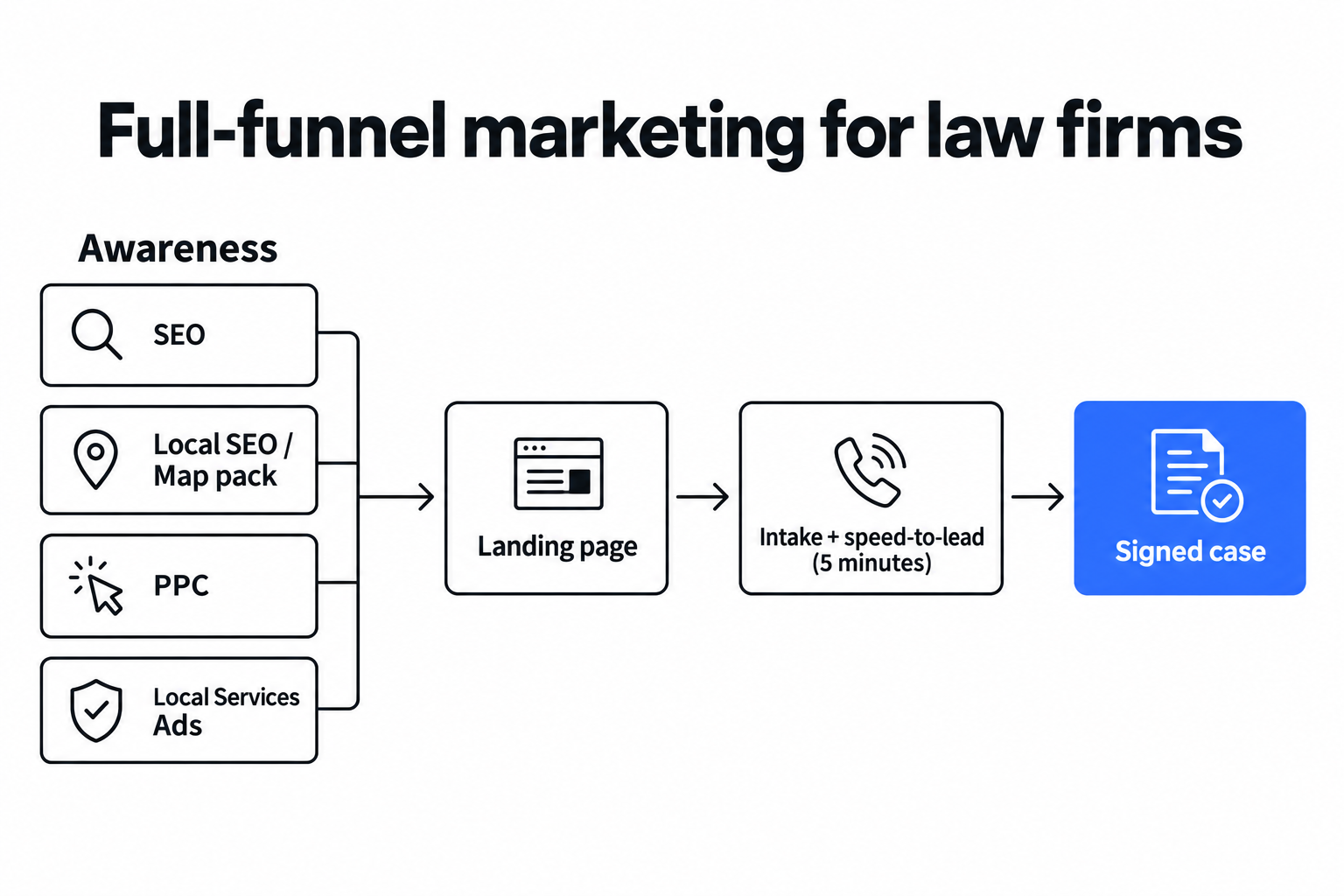
Build the organic foundation first
Law firms put more budget into SEO than any channel, and for good reason: it compounds while paid spend resets to zero every month. In CallRail's 2026 legal marketing research, firms named SEO their top acquisition channel at 54%. Content and technical SEO win the informational searches a hurt person makes before they are ready to call. (We cover the legal SEO playbook in law firm SEO.)
Local SEO is where cases actually come from. The map pack sits above organic results and captures the "lawyer near me" intent that signs clients. Google weighs the Google Business Profile, proximity, and reviews here, so the work concentrates on the profile, a steady flow of recent reviews, and consistent citations. Most agencies deliver this at scale through white-label local SEO and the firm-owner mechanics in law firm local SEO.
Layer paid search on top of the foundation
Once organic is working, paid search buys the high-intent traffic you cannot wait months to earn. Legal is the priciest vertical in Google Ads, with a blended average cost per click of $9.87 and personal injury terms running $150 to $300 in competitive metros. That cost punishes sloppy targeting, so paid search demands tight match types, an aggressive negative keyword list, and dedicated landing pages, not the firm's homepage.
Local Services Ads deserve their own line. Google replaced the Screened and Guaranteed badges with a single Google Verified badge in late 2025, and LSAs now charge per lead instead of per click. For a firm nervous about $300 clicks, paying only for a lead is an easy sell. The full paid breakdown lives in PPC for lawyers.
Reviews and reputation sit underneath everything
Reviews are not a side project. They feed local rankings as a direct signal, they decide whether a searcher picks the firm after they find it, and in 2026 review recency matters more than the raw count. Build a review engine the firm actually runs: a request that goes out after every resolved matter, a response process for both the good and the ugly, and a cadence that keeps fresh reviews coming.
For a legal client, reputation work doubles as risk work. One unanswered one-star review about a missed call undoes a month of ad spend. Make review generation and response a standing part of the retainer, not a favor you do when a client complains.
Intake and speed-to-lead decide whether any of it pays
You can run flawless SEO, local, and paid, and the firm can still lose every case to its own phone. Firms that respond to a lead within five minutes convert at roughly 21%, against 2.3% after thirty minutes, which makes the fast firm 21 times more likely to sign the client. Yet the median law firm takes 13 minutes to respond and about a quarter of firms never respond at all.
Treat intake as part of your funnel, because the client will blame you when the leads you generate go cold. Push the firm toward instant lead routing, after-hours coverage, and bilingual response in Spanish-speaking markets. AI intake that answers every lead in seconds, day or night, is one way firms stop wasting the expensive traffic you send them. The deeper case for response time lives in speed to lead for PI firms.
Measure signed cases, or lose the account
Legal clients do not renew on impressions. Set up call tracking with recording where the law permits, and feed offline conversions back into the ad platforms so bidding optimizes toward signed cases, not raw clicks. Report in the client's language: cases signed, cost per signed case, and the channels that produced them.
Marketing budgets in legal run 5 to 15% of gross revenue, with firms typically splitting around 45% to SEO, 30% to paid search, 10% to social, and the rest to traditional. Your reporting is what justifies that split and earns the next budget increase. A report that ties spend to signed cases makes the renewal automatic. A report full of vanity metrics ends the relationship the first slow quarter.
Frequently asked questions
What should a law firm's digital marketing budget be? Most firms spend 5 to 15% of gross revenue on marketing, depending on growth stage. The common digital split is roughly 45% to SEO, 30% to paid search, 10% to social, and 15% to traditional, though the right mix depends on the firm's positioning and market.
Which channel brings law firms the most cases? SEO and local search produce the most durable case flow because they compound and capture high-intent "lawyer near me" searches. Paid search and Local Services Ads add speed by buying high-intent traffic now. The strongest strategy runs organic as the foundation and layers paid on top.
Why does legal digital marketing cost more than other industries? A single signed case can be worth tens of thousands in fees, so firms bid aggressively for the same searchers. Legal posts the highest average cost per click of any industry, which raises the cost of every paid channel and makes targeting and intake discipline essential.
Digital marketing for law firms works when the channels stop acting like separate services and start acting like one funnel: positioning feeds SEO and local, paid search buys the intent you cannot wait for, reviews hold it all up, and intake converts the traffic into cases you can report. Run it that way and the retainer renews itself.
We publish the full-funnel playbooks agencies use to win and keep legal clients. Subscribe and get the next one in your inbox.