A law firm hands you a $20,000 monthly ad budget and expects signed cases, not a report full of impressions. Legal is the most expensive vertical in Google Ads, so every mistake you make with that money shows up fast. One misread keyword can burn a four-figure day before lunch.
The agencies that keep legal clients are the ones who treat the click as the cheap part. The expensive part is everything that happens after it. If you want to win and hold legal ad budgets, you run PPC like the firm's revenue depends on it, because it does.
Legal clicks cost more than any other industry
Attorneys and legal services post the highest average cost per click of any industry in WordStream's 2026 benchmarks, at $9.87 across all legal terms. That blended number hides the real pain. Personal injury keywords in competitive metros run $150 to $300 a click, and a single click on a PI term averages around $195. Mass tort phrases like "mesothelioma lawyer" clear $300.
The math behind those prices is simple. One signed PI case can be worth tens of thousands in fees, so firms bid against each other until the click price climbs to meet the case value. In major markets, 500-plus firms chase the same searchers.
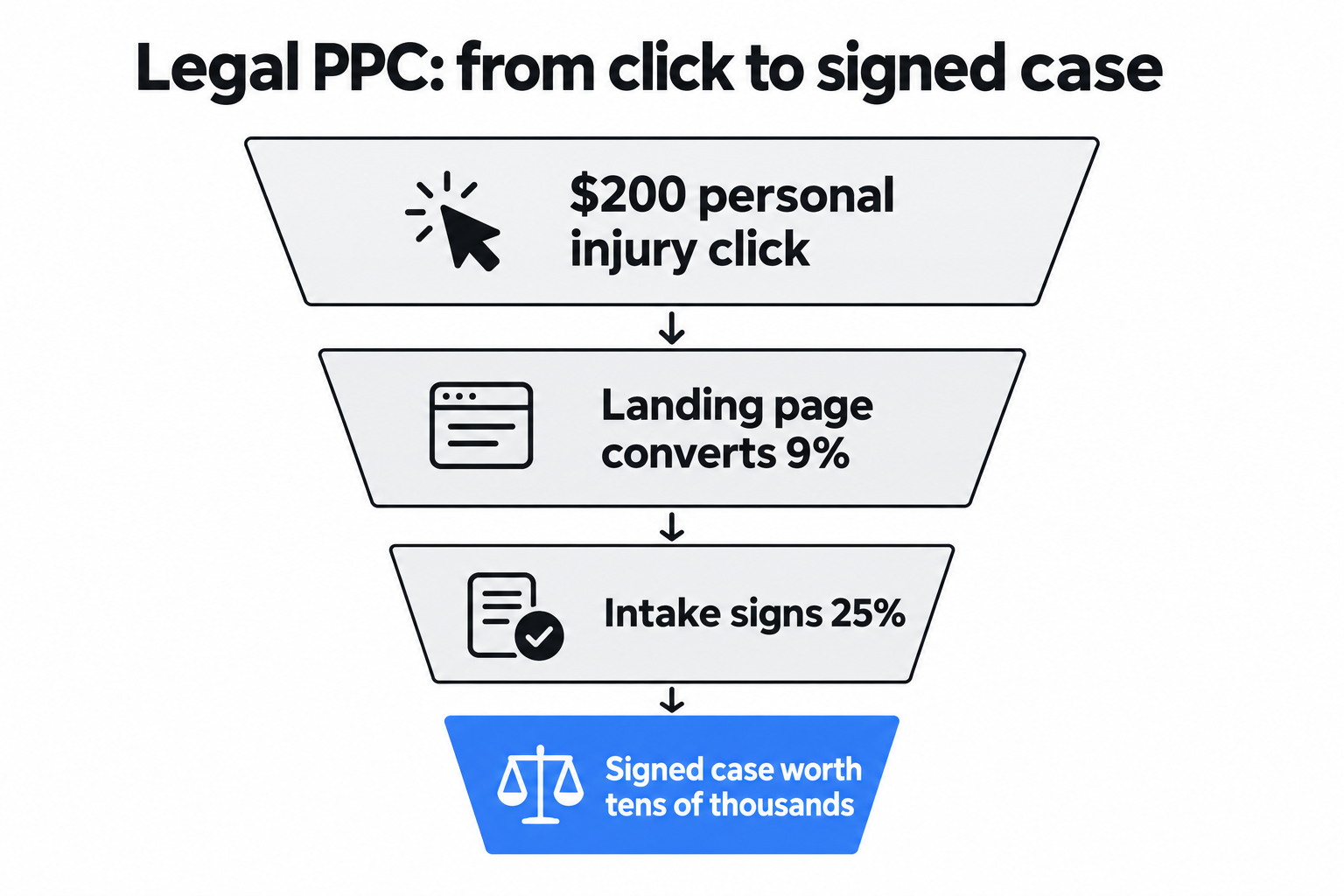
Your job is to make that spend survivable. A firm paying $200 a click cannot afford a 2% conversion rate on a slow intake process. The budget only works when speed, targeting, and the landing page all pull together.
Google moved legal ads into a pay-per-lead model
Google retired the Google Screened and Google Guaranteed badges in late 2025 and replaced them with a single Google Verified badge. Any law firm running Local Services Ads now carries it, and getting it takes real work: active bar membership verified by state, a license in good standing, proof of professional liability insurance, and a background check on firm ownership.
Local Services Ads also moved into Google Ads as a Performance Max campaign type built for pay-per-lead goals. That changes how you sell the service. LSAs charge per lead instead of per click and sit above the traditional text ads, so a firm pays only when someone calls or messages. For a client terrified of $300 clicks, "you pay for a lead, not a click" is an easy yes. Run LSAs and search ads together, not as rivals.
Keep the eligibility bar in your onboarding checklist. Personal injury qualifies, along with family, criminal, DUI, immigration, estate, and most other practice areas. If the firm cannot clear insurance and licensing, the LSA conversation stops before you waste a month.
The negative keyword list is your margin
The fastest way to lose a legal client is to let their budget fund clicks that will never sign. Someone searching "free legal aid," "lawyer salary," or "paralegal jobs" costs the firm $150 and converts to nothing. Build the negative keyword list before a single ad goes live, then add to it every seven days. If you are not pruning weekly, you are paying for researchers, job seekers, and competitors.
Tight match types matter more in legal than anywhere else. Broad match on a $200 keyword is an invitation to waste. Start restrictive, watch the search terms report, and expand only into queries that show case intent.
The landing page decides whether the click pays off
Sending a $200 click to a firm's homepage throws money away. Legal PPC converts at about 9.27%, nearly double the 4.8% average across all industries, but only when the page does its job. Match the page to the ad, name the practice area, and put the trust signals a hurt person looks for: attorney bios, real reviews, case results, and the firm's track record.
Remove the navigation on bottom-of-funnel pages. Stripping the menu lifts conversion 20 to 30% because it kills the exits. One clear action beats five competing links. Make the phone number tappable on mobile and keep the contact form to the fields the firm actually needs.
Speed to lead is where most legal PPC dies
You can run a flawless campaign and still lose the case to response time. Firms that answer a lead within five minutes convert at roughly 21%, against 2.3% after thirty minutes, which makes the fast firm 21 times more likely to sign the client. Yet the median law firm takes 13 minutes to respond, and about a quarter of firms never respond at all.
Sit with that gap. Your client pays $200 for the click, you build a 9% landing page, the lead comes in at 9 p.m. on a Friday, and a voicemail box answers. The case calls the next firm on the results page. The most profitable optimization in legal PPC often has nothing to do with the ad account. It lives in what happens in the first five minutes after the form submits. AI intake that answers every after-hours lead instantly, in English or Spanish, is one way firms stop leaking the clicks you worked to earn.
Track signed cases, not clicks
Legal clients do not care about click-through rate. They care about cases. Set up call tracking with recording where the law allows, and feed offline conversions back into Google Ads so the system learns which clicks became signed clients, not just which clicks happened. When you tell Google that a $250 click produced a $40,000 case, its bidding starts chasing quality instead of volume.
This is also how you keep the account. A report that says "47 signed cases from $18,000 in spend" renews the contract. A report full of impressions and a vague "brand lift" gets you fired when the firm's quarter looks thin.
Frequently asked questions
How much should a law firm budget for PPC? Most firms put around 30% of their marketing budget into paid search, and total marketing runs 5 to 15% of gross revenue depending on growth stage. In practice, a small firm needs enough monthly budget to absorb $150 to $300 clicks and still gather conversion data, which usually means a floor of several thousand dollars a month in competitive metros.
Are Local Services Ads better than Google Ads for lawyers? They serve different jobs. LSAs charge per lead, sit at the top of the page, and carry the Google Verified badge that builds trust. Search ads give you keyword control and custom landing pages. Run both, and lead with LSAs for firms nervous about high click costs.
Why is legal PPC so expensive? A signed personal injury case can be worth tens of thousands in fees, so firms bid aggressively for the same searchers. In major metros, hundreds of firms compete for the same keywords, pushing clicks to $150 to $300 and beyond.
Legal PPC rewards the agency that connects spend to signed cases and punishes the one that stops at the click. Get the negatives, the landing page, and the speed-to-lead handoff right, and the expensive click starts to pay.
We break down what actually works in legal marketing, one agency-tested playbook at a time. Subscribe and get the next one in your inbox.