You can sell local SEO to twenty clients. Delivering it for twenty clients is where most agencies break. Each one needs its Google Business Profile optimized, citations cleaned, reviews worked, and a monthly report that proves the map pack moved. Do that by hand across a full book and you either hire a team you cannot afford or let quality slip until clients churn.
White-label local SEO solves the delivery problem without the headcount. A production partner does the work under your brand, you own the client and the margin. Done well, it turns local SEO from a service you dread fulfilling into the most repeatable recurring line on your P&L.
The map pack is won on three signals, not a hundred
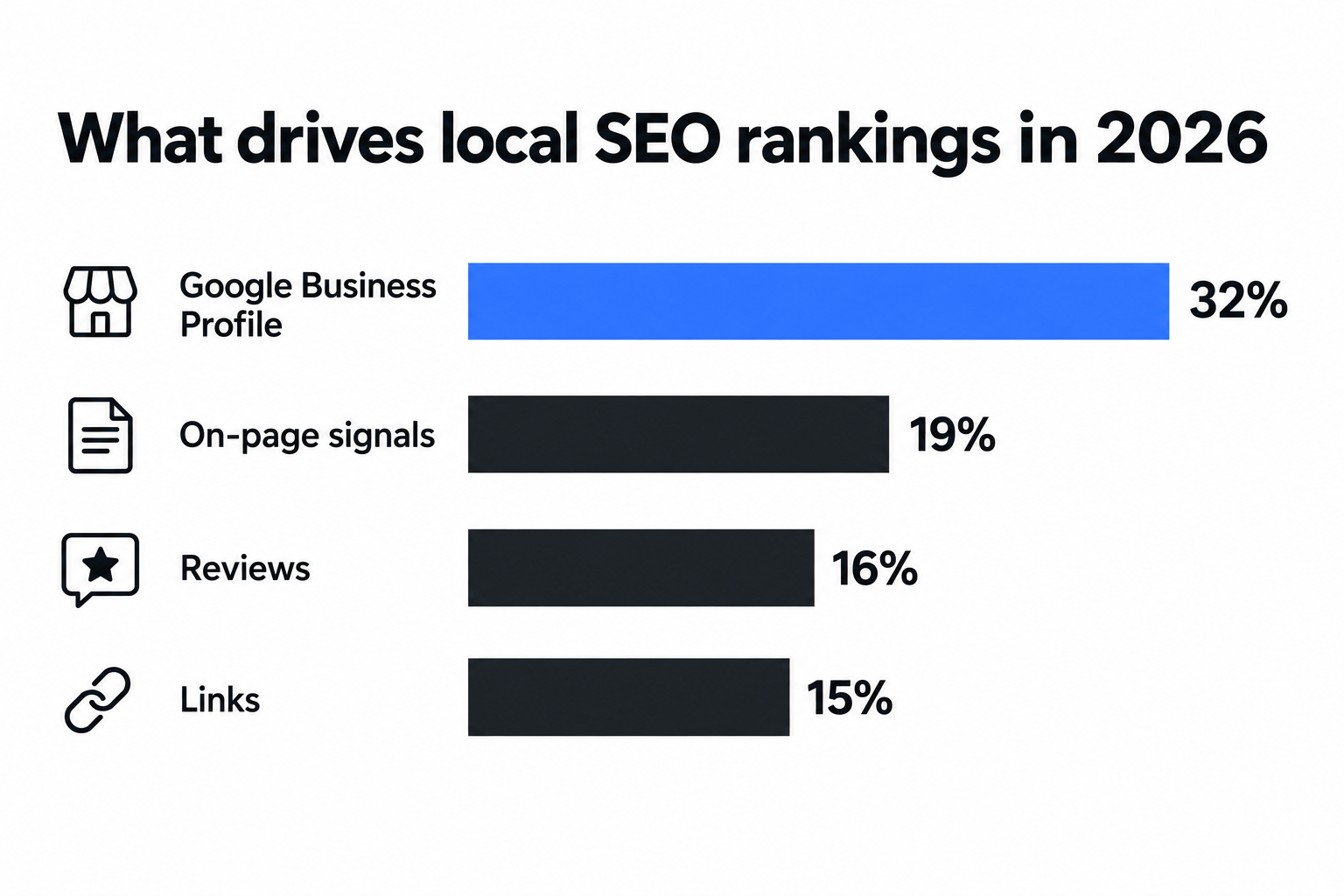
Google ranks local results on relevance, distance, and prominence. Strip away the noise and 2026 ranking weight concentrates in a few places you can actually move: Google Business Profile signals carry about 32% of the weight, on-page signals 19%, reviews 16%, and links 15%.
The single strongest factor a business fully controls is the GBP primary category. Pick it wrong and nothing else saves the ranking. Reviews come next, and in 2026 review recency beats raw review count, so a steady drip of fresh reviews outperforms a pile of old ones. Behavioral signals climbed too: when searchers call, tap for directions, or browse photos, Google reads that as validation and pushes the profile up.
A white-label partner who understands this does not chase a hundred tweaks. They nail the category, run the review engine, keep citations consistent, and build local links. That focus is what scales.
White-label delivery is how one person services a full book
The model is straightforward. You sell and own the client relationship. A white-label provider runs fulfillment under your name: GBP optimization, 15 to 20 quality citations, review generation and response, and monthly reporting with your logo on it. The client never sees the provider.
That split lets a lean agency carry a book that would otherwise need a four-person SEO team. You stay in strategy, account management, and sales, which are the parts clients pay you for and the parts that keep them. The repetitive production work, the part that does not scale with your time, lives with the partner.
Vet the partner on the work, not the dashboard. Ask who writes the GBP posts, how they source citations, whether review requests go out on a real schedule, and how they handle a suspended profile. A pretty report means nothing if the category is wrong and the citations are inconsistent.
The margins hold up when you price for them
White-label local SEO runs profitable because the wholesale-to-retail spread is wide. Wholesale local packages sit around $300 to $900 a month. A foundational local package that includes GBP optimization, 15 to 20 citations, review work, and monthly reporting typically costs $300 to $600 wholesale and sells at $800 to $1,500 retail. That is a 50 to 60% gross margin on work you did not personally do.
Across the industry, agencies that price correctly land gross margins of 45 to 60%, with markups of 30 to 100% over wholesale. The mistake is underpricing to win the deal, then watching a thin margin get eaten by one demanding client. Price for the account management the client will actually need, not the floor the provider quoted you.
Recurring is the real prize. A local SEO retainer renews month after month as long as the rankings hold, which turns a book of ten clients into predictable revenue you can forecast and borrow against. One-off projects force you to resell constantly. Retainers compound.
Reporting is the product the client actually buys
Clients do not see the citations you built. They see the report. Make it prove the three things they care about: map pack position for their money keywords, calls and direction requests from the profile, and reviews gained this month. Tie those to the outcome, which for a local business is phone calls, not rankings for their own sake.
Standardize the report across your book so you can produce it at scale, and brand it as yours. A client who opens a clean monthly report showing their position climbing in the map pack renews without a second thought. A client who gets a wall of metrics they cannot read starts shopping. For local service clients who live or die on inbound calls, the connection from ranking to signed business is the whole story, so an agency that pairs map-pack gains with a client whose intake answers every call keeps that client for years.
Frequently asked questions
What does white-label local SEO include? A standard package covers Google Business Profile optimization, local citation building (usually 15 to 20 quality citations), review generation and response, on-page local optimization, and monthly performance reporting. The provider does the work under your brand while you own the client.
What margin can an agency make reselling local SEO? Agencies that price correctly run 45 to 60% gross margins. A package that costs $300 to $600 wholesale commonly sells for $800 to $1,500 retail. Markups across the industry range from 30 to 100% over the wholesale rate.
How is local SEO different from regular SEO for the map pack? Local SEO targets the map pack and Maps results, where Google weighs the Google Business Profile, proximity, and reviews far more than for standard organic listings. The GBP primary category and recent reviews drive most of the movement, which is why local work focuses there rather than on broad content.
White-label local SEO lets you sell a service you can deliver at scale, protect your margin, and keep clients on a retainer that renews itself. Get the partner, the pricing, and the report right, and the map pack becomes a recurring revenue engine instead of a fulfillment headache.
We publish the delivery models and margin math that let agencies scale services like this. Subscribe and get the next playbook in your inbox.