
A client asks if you run Google Ads. You do SEO and web, not paid search, so you say no. They hire a second agency for the ads, that agency starts talking about the website and the rankings, and six months later you are the vendor on the way out. You lost the account by declining a service you could have bought wholesale that afternoon.
White-label PPC fixes that. You sell paid search under your own brand, a specialist runs the campaigns behind the scenes, and the client never knows there is a second company involved. You keep the relationship, add a line of recurring revenue, and hire nobody. Here is how the model actually works and how to run it without getting burned.
White-label PPC is a specialist you rent by the client
You sign up with a white-label PPC provider. For each client you bring, that provider builds and manages the Google Ads, Microsoft Ads, or paid social account: keyword research, ad copy, bid management, landing-page feedback, and monthly reporting. The work ships under your logo. You set the client price, pay the provider a wholesale rate, and keep the spread.
The difference from a referral is control. A referral hands the client to someone else and hopes for a kickback. White-label keeps the contract, the invoice, and the account manager seat with you. The specialist is a subcontractor your client never meets.
A normal engagement covers account setup, keyword and competitor research, ad copywriting, conversion tracking, ongoing bid and budget management, and a monthly report you can brand. What it does not cover is the ad spend itself. The client pays Google directly, or pays you and you pass it through. Keep management fees and media spend on separate lines so nobody confuses your margin with their budget.
The markup math decides whether this is worth it
White-label PPC providers price one of two ways. Most charge a flat management fee, commonly $500 to $2,500 per month per client account for standard work, with budget options in the $200 to $500 range. Others charge a percentage of ad spend, usually 10% to 15%.
You mark that up. The common structure is a 25% to 50% markup over the provider's cost, with a target of at least a 50% gross margin on the management fee. If your provider charges $1,000 a month for a client, you bill $2,000 and keep $1,000. On the percentage model, agencies bill the client 15% to 20% of ad spend while paying the provider 10% to 12%, and pocket the gap.
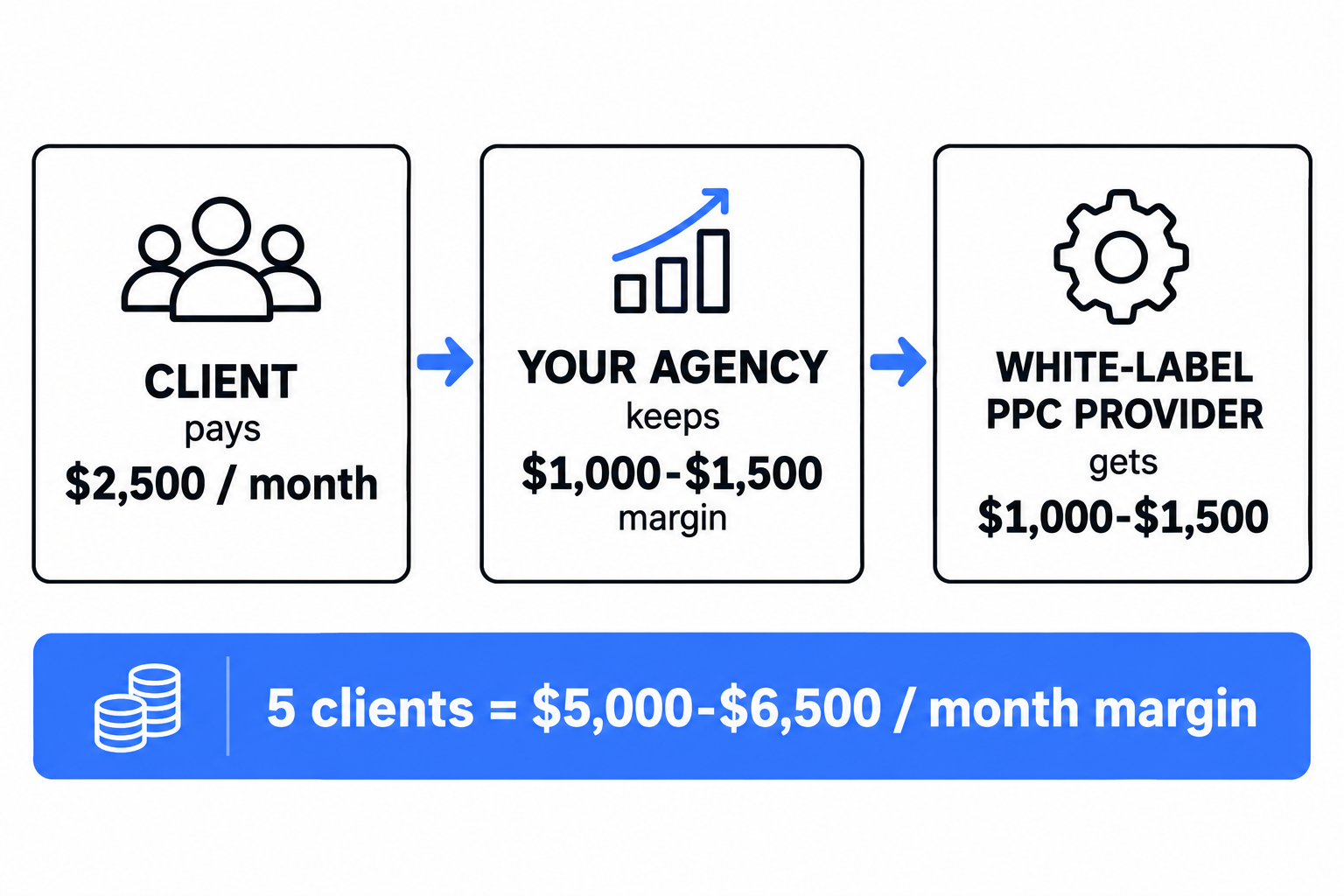
Run it across a book of business and the numbers compound. Five PPC clients billed at $2,500 a month each bring in $12,500 in monthly revenue. Pay the provider $6,000 to $7,500 across all five and you clear $5,000 to $6,500 a month in margin, on work you are not doing yourself.
Two pricing mistakes to avoid. Do not bill PPC as a percentage of spend if your clients run small budgets, because a $1,500 account at 15% pays you $225 and no specialist will do good work under that. And do not undercharge to win the deal, because a thin margin leaves nothing to absorb a difficult account, and difficult accounts are the ones that email you on a Sunday.
Legal clients make PPC worth reselling
If you serve law firms, paid search is one of the highest-value services you can add. Legal carries the most expensive clicks of any industry, with an average cost per click near $9.87 and personal-injury terms in major metros running $150 to $500 for a single click. Mass-tort keywords like "mesothelioma lawyer" clear $300 and climb past $900.
Those prices mean a law-firm client is spending real money every month and watching it closely. An agency that manages that spend well, and reports on it clearly, becomes hard to fire. It also means the margin on the management fee is healthy, because a firm paying $10,000 a month to Google does not flinch at a $2,000 management fee. For the full picture on the legal vertical, see our guide to PPC for lawyers.
The catch with expensive clicks is the same one that kills most legal PPC: the firm pays $300 for a click, the click turns into a form fill at 2 a.m., and nobody answers it until Tuesday. The ad budget buys the click. Whether the click becomes a signed case depends on what happens after it lands, which is a problem you can solve separately and charge for.
Vetting a provider is the whole game
The provider is your product. A bad one does not just lose a campaign, it loses the client who trusted your name on the report. Screen hard before you sign.
Ask who actually touches the account. Some providers assign a certified strategist per client, others route everything through junior staff or a dashboard. Ask how many accounts each manager carries, because a strategist running 60 accounts is running none of them well. Get a sample report and read it as your client would. If you cannot understand what happened and why, neither will they.
Check the white-label terms in writing. The provider should never contact your client, never brand anything with their own name, and never appear on a call unless you invite them. Confirm who owns the Google Ads account if you part ways, because an account you cannot take with you is a hostage. And ask about their communication speed, because when a client's campaign breaks, your reputation depends on how fast the invisible partner moves.
Start with one or two accounts before you move your whole roster. A provider that performs on a small test earns the rest. One that goes quiet on a test just told you everything.
Reporting is what keeps the client yours
The specialist runs the ads, but the client belongs to whoever explains the results. If your monthly touchpoint is a forwarded PDF with no human attached, you have trained the client to wonder what they are paying you for.
Own the report. Rebrand it, add a short written summary in plain language, and get on a call once a month to walk through what changed and what you are doing next. Tie the numbers to the outcome the client cares about, which is signed clients or booked jobs, not impressions. The agencies that lose white-label accounts are the ones that became a pass-through. The ones that keep them stayed the strategist in the client's eyes, even when a subcontractor did the button-clicking.
Frequently asked questions
How much does white-label PPC cost an agency? Providers typically charge a flat management fee of $500 to $2,500 per month per client account, or 10% to 15% of ad spend. Budget providers run $200 to $500 a month. You mark that up 25% to 50% and aim for at least a 50% gross margin on the management fee.
How is white-label PPC different from referring the work out? A referral hands the client to another company and hopes for a commission. White-label keeps the contract, the invoice, and the client relationship with you. The provider works under your brand and never contacts your client, so you stay the agency of record.
Is white-label PPC profitable for a small agency? Yes, because you add recurring revenue with no new hires. Five clients billed at $2,500 a month can clear $5,000 to $6,500 in monthly margin after paying the provider. The profit scales with your client count, not your headcount.
White-label PPC is one of the fastest ways to add recurring revenue without adding payroll, and it pairs naturally with the SEO and web work you already sell.
We break down how agencies add and price services like this every week. Subscribe and get the next playbook in your inbox.