A weak personal injury intake form costs you cases before you ever read them. A new client describes a rear-end collision at a red light. Your form captures a name and a phone number, and the detail that decides the claim walks out the door. Three weeks later the skid marks are gone, the witness has moved, and the client signed with the firm that asked better questions first.
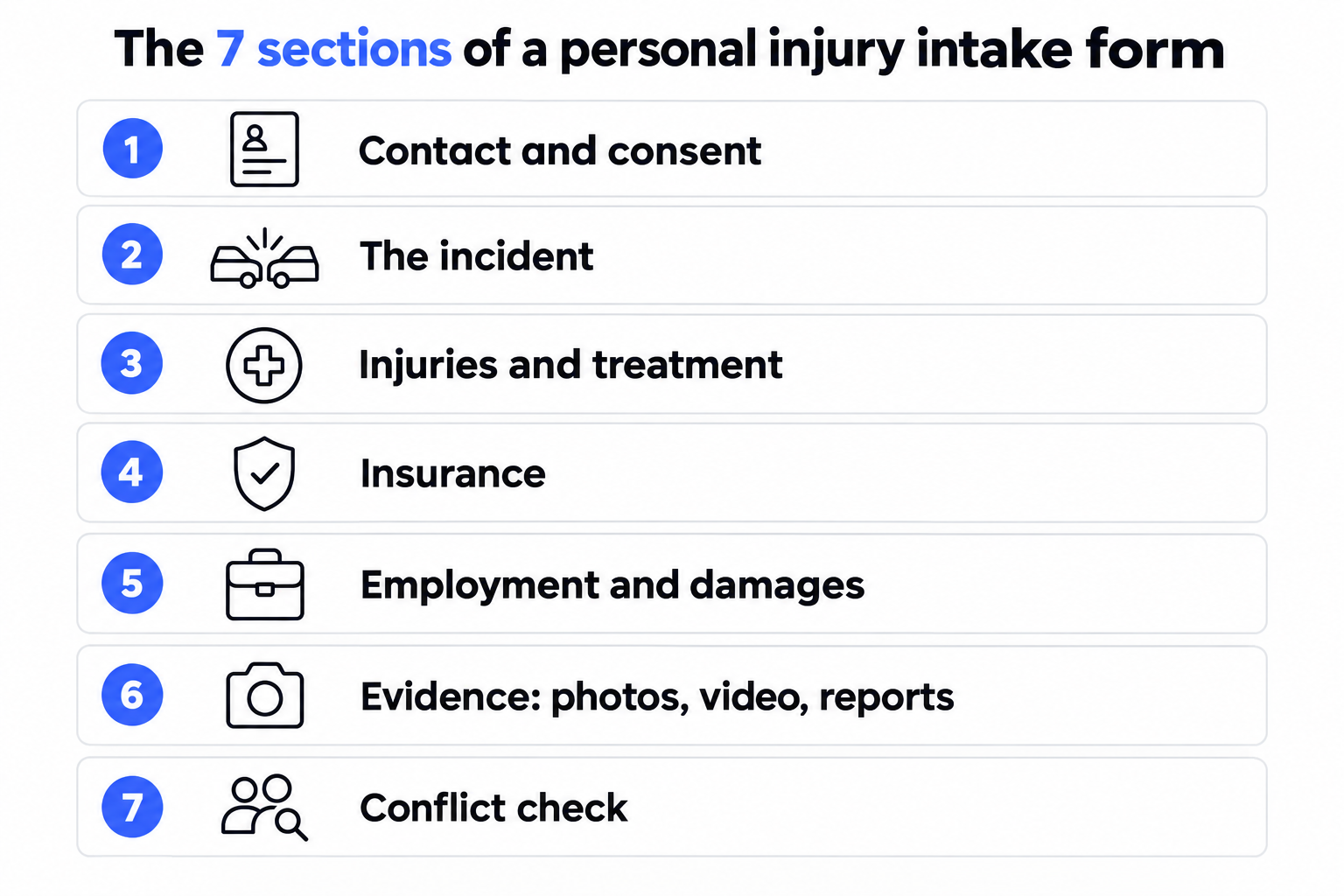
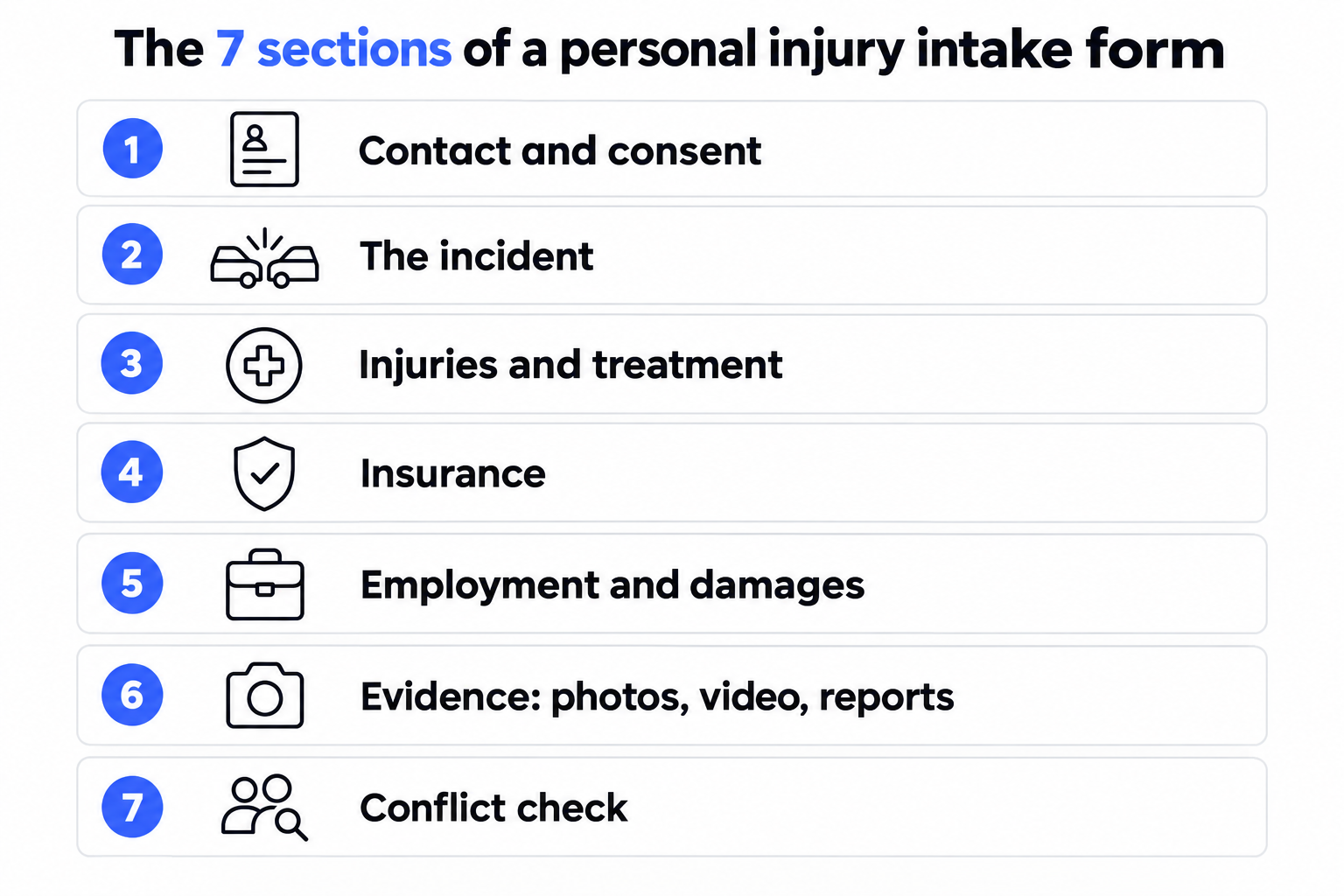
Your intake form is not paperwork. It is the first draft of the case. In 2027, with more intake happening after hours and online, the firms that win are the ones that capture the full story the moment someone reaches out. This is a field-by-field guide to what a modern personal injury intake form should ask, organized by section, so you can build or rebuild your own.
A personal injury intake form has to be fast and complete at once
Two things are true about intake at once, and they pull against each other. Speed wins cases: an analysis of roughly 3.5 million leads found that responding within one minute, rather than waiting even a minute longer, lifted conversion by 391%, close to four times (Velocify). Yet the average business takes about 42 hours to answer an online inquiry, and roughly a quarter never reply at all (Harvard Business Review). The firms that reply first, fast, usually keep the case. Our roundup of the speed to lead statistics for PI firms has the full research.
But a fast reply that misses half the story just forces a second call, and the second call is where leads leak out. So the form has two jobs: collect everything you need on the first pass, and do it fast enough that the person is still paying attention.
Contact and consent come first for a reason
Start with how to reach the person and permission to do it. Capture full name, phone, email, and the best time and method to contact them. Add a simple consent line that lets you follow up by call and text, which matters if any part of your outreach is automated.
One line to include and never skip: a statement that completing the form does not create an attorney-client relationship and that nothing shared is legal advice until you accept the case. Keeping that clear at intake protects you and sets expectations with the client.
The incident section is the spine of the case
This is where most thin forms fall short. Ask for the date, time, and exact location of the incident, and a plain description of what happened in the client's own words. For a motor vehicle case, capture road and weather conditions, direction of travel, and whether a citation was issued.
Then ask the questions that preserve a claim before evidence disappears:
- Was a police or incident report filed, and do you have the report number?
- Were there witnesses, and do you have their names and contact information?
- Who else was involved, and do you have their information?
The statute of limitations is a trap worth flagging here. Deadlines to file a personal injury claim vary widely by state, from as little as one year to six, and special rules apply to minors and certain claim types (Forbes Advisor). Capturing the incident date at intake is what lets you flag a near-deadline case before it is too late.
Injuries and treatment show you the value early
Ask what injuries the person sustained, the symptoms they have now, and how severe they are. Then trace the medical trail: did they seek treatment, where, and who are the providers? Are they still treating or have they been released?
Include a short medical history prompt for pre-existing conditions and current medications. This is not busywork. Pre-existing conditions shape causation arguments, and knowing them at intake stops a surprise during litigation.
Insurance determines whether a strong case can actually pay
A compelling injury with no coverage behind it is a hard case to fund. Capture the client's own insurance, the other party's insurer and policy details if known, and any health insurance or Medicare and Medicaid status that could trigger a lien. Ask whether the client has already spoken to any insurance company and whether they gave a recorded statement, because that answer can change your strategy immediately.
Employment and damages quantify the claim
Lost income is often a major piece of the demand, so ask about employment status, employer, role, and time missed from work. Capture out-of-pocket costs too: medical bills, property damage, transportation to appointments, and anything else the injury has cost them. You do not need exact figures at intake. You need enough to size the claim and know what records to request.
The evidence section is where modern intake pulls ahead
Visual evidence captured close to the time of an accident is some of the strongest proof a claim can have, preserving details that fade fast like skid marks, vehicle positions, and visible injuries (Nolo). Yet most intake forms only ask whether photos exist. They never actually collect them.
Ask directly: do you have photos or video of the scene, your injuries, or the property damage? Do you have the police report, medical bills, pay stubs, or any letters from an insurer? Then give the person a way to hand those files over right then, while they are motivated, rather than hoping they email them later. The gap between "do you have photos" and "upload them now" is the gap between a documented file and a he-said-she-said claim.
The conflict check protects the firm
Before you promise anything, capture the names of every party involved, including the opposing driver, employer, or business. A quick conflict check against your existing clients and matters at intake prevents an ethics problem later. Build the fields for it into the form so the check happens every time, not only when someone remembers.
How AI intake captures these fields without a static form
A PDF or web form assumes the injured person will sit down, read every field, and type careful answers at 9pm on a Sunday. Many will not. This is the case for conversational intake.
Burt is an AI intake tool for personal injury firms that captures these same fields through a chat and text conversation on your website, 24/7, in English and Spanish. Instead of a static form, it asks the incident, injury, insurance, and evidence questions one at a time, in plain language, and can collect photos or video of the injury during the conversation. The output is a structured file with the sections above already filled in, waiting for your team. It is one way to get the completeness of a long form without the drop-off of one.
If you are weighing your options, our guides to AI intake for personal injury firms and the personal injury law firm software and tech stack go deeper on where intake fits with the rest of your tools.
Frequently asked questions
What should a personal injury intake form include? At a minimum: contact and consent, the incident details, injuries and treatment, insurance, employment and damages, evidence, and a conflict check. Each section exists to answer one question, whether this is a case you can win and fund. Capturing the incident date and injury details on the first pass matters most, since those drive deadlines and case value.
Is there a free personal injury intake form template or PDF I can use? Plenty of firms publish a downloadable personal injury intake form template or PDF, and they are a fine starting point. Treat them as a skeleton. Adapt the incident section to the case types you handle most, add a real evidence-upload step, and make sure the consent and conflict-check fields are built in. We offer a free checklist below that covers every section in this guide.
How long should a personal injury intake form take to complete? Most clients can finish a thorough form in 20 to 30 minutes. If yours takes much longer, it is probably asking for detail that belongs in the first meeting, not intake. The goal at intake is enough to size the claim, flag the deadline, and capture evidence before it disappears, not a complete case file.
Your intake form is the first thing a hurt person sees from your firm and the first draft of the case your team will build. Getting the sections right is the difference between a file that is ready to work and a file full of gaps.
Subscribe to get our free personal injury intake checklist, every section in this guide as a build-ready template you can adapt to your firm.