An injured person fills out the contact form on your website at 9pm on a Sunday. They are scared, in pain, and they just sent the same message to three other firms. Whoever answers first usually gets the case. The speed to lead statistics below explain why, and they have held up for more than fifteen years of research. If your firm takes hours to reply to a website inquiry, these numbers are the cost.
This is a roundup of the real studies on response time and lead conversion, with the source for every figure and what each one means for a personal injury practice in 2027.
Speed to lead, defined
Speed to lead is the time between a potential client reaching out and your firm responding to them. For a PI firm, that usually means the minutes between someone submitting your website form (or your chat or text widget) and a real reply landing back with them.
That is the speed to lead meaning in plain terms: how fast you answer a new inquiry. It is not how fast you sign the case or how fast you return a scheduled call. It is the very first response to a cold, inbound signal of interest. The research is clear that this one gap decides more cases than almost anything else in your intake.
The speed to lead statistics that matter most
Here are the key sourced findings, with the implication of each for your firm.
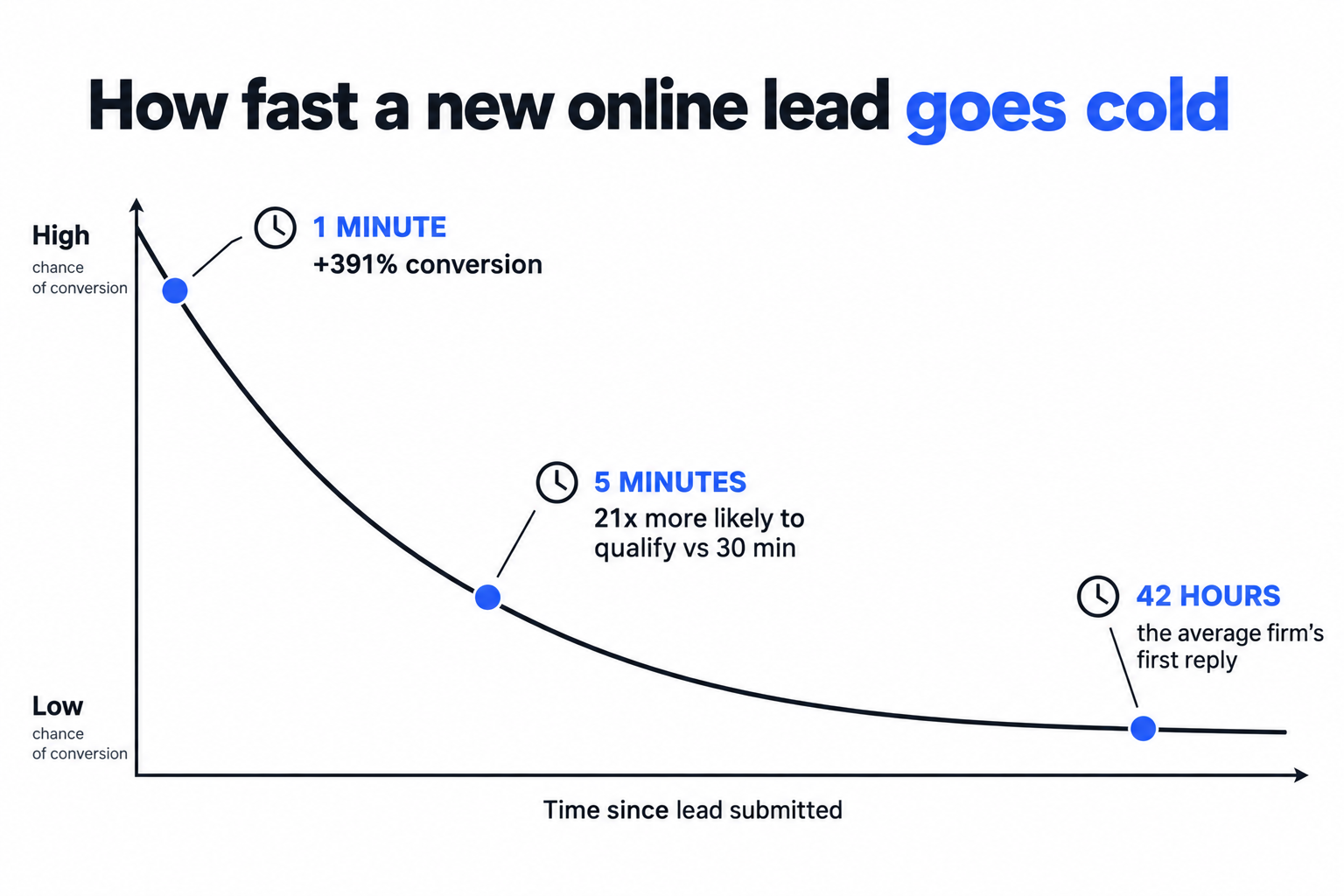
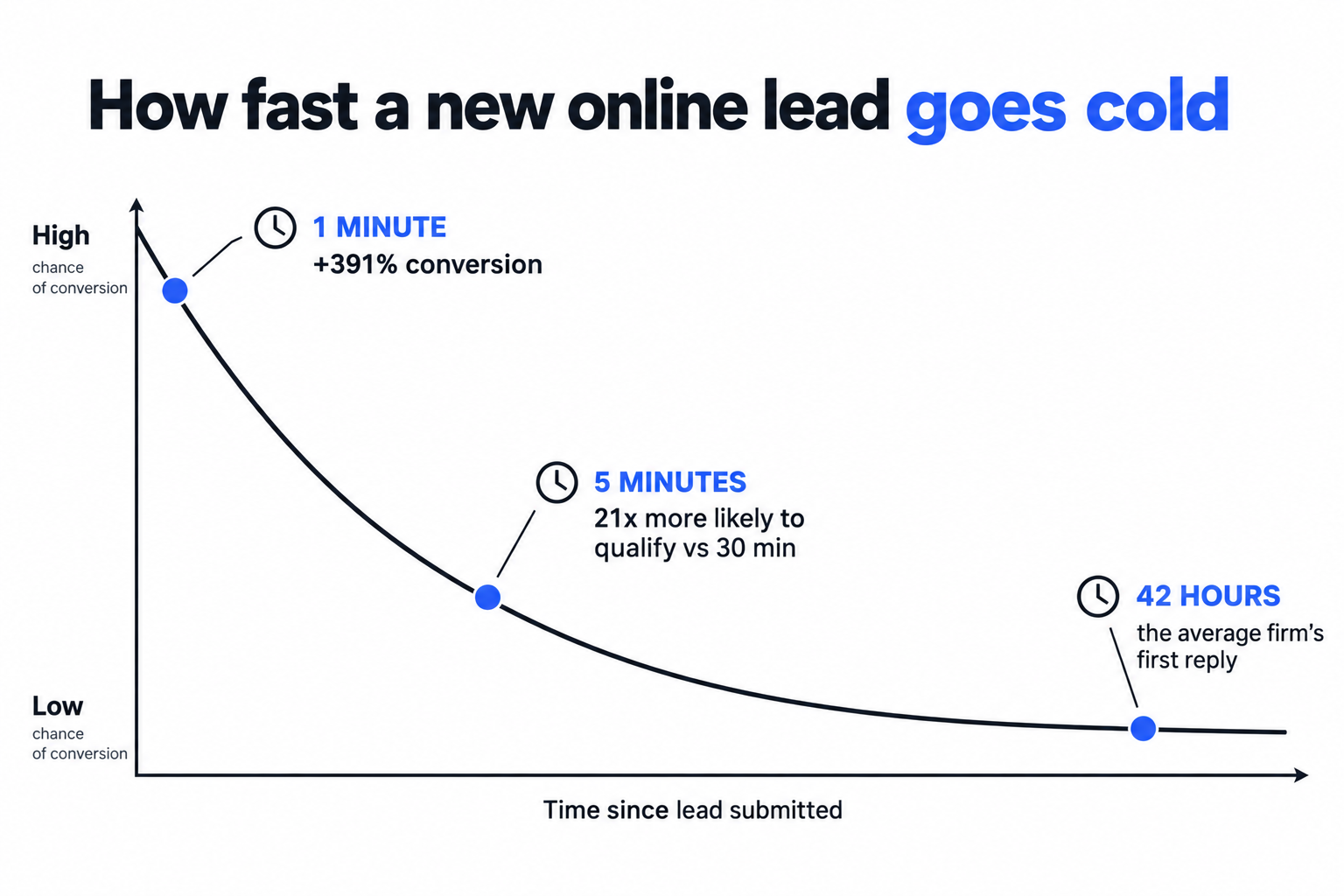
1. The average first response to an online lead is 42 hours. In the Harvard Business Review study "The Short Life of Online Sales Leads" (2011), researchers audited 2,241 US companies by submitting test inquiries. The average first response time was about 42 hours, and 23% of firms never replied at all. For you, that average is the opening. Most practices are slow, so a fast reply is a real edge, not a nice-to-have.
2. Reaching a lead in 5 minutes makes you 21 times more likely to qualify it. The InsideSales.com and MIT study led by Dr. James Oldroyd (the Lead Response Management Study, 2007) reviewed more than 15,000 leads and over 100,000 contact attempts across three years. The odds of qualifying a lead were 21 times higher when the lead was reached within 5 minutes versus 30 minutes. The odds of reaching the person at all were 100 times higher. Half an hour feels fast to a busy office. The data says it is already too late.
3. Answering within the first hour makes you 7 times more likely to qualify the case. The same Harvard Business Review research found that firms that tried to contact a lead within an hour were 7 times more likely to qualify it than firms that waited even one hour longer, and more than 60 times more likely than firms that waited 24 hours or more. A reply the next morning is not a slightly worse version of a reply tonight. It is a different outcome.
4. The odds of qualifying a lead drop by more than 6 times inside that first hour. The Lead Response Management Study also measured the decay minute by minute. The odds of reaching a lead fell by more than 10 times over the first hour, and the odds of qualifying it fell by more than 6 times. The lesson is that a lead does not stay warm while it sits in an inbox. It cools fast, and it cools inside the window most firms treat as normal.
5. Responding within one minute can lift conversion by 391%. Velocify (formerly Leads360) analyzed roughly 3.5 million leads from more than 400 companies and found that calling a lead within one minute, rather than after two, raised conversion by 391%, close to 4 times. Our own site cites that figure because it matches what we see: the difference between "right now" and "in a few minutes" is enormous. For an online inquiry, speed to lead is won in seconds, not minutes.
6. Only 7% of companies respond within 5 minutes. Drift's 2017 Lead Response Report tested 433 companies and found just 7% replied to an inbound lead within five minutes. More than half took five or more days or never responded. Read that next to stat #2 and the opportunity is obvious. The bar for "fast" is low, and most of your competitors are not clearing it.
7. Buyers tend to pick whoever answers first. Across industries, research compiled by Chili Piper found that 78% of B2B buyers choose the vendor that responds first. That figure is from business buying, not injury claims, so treat it as a pattern rather than a PI number. The pattern still fits: an injured person who gets a caring reply in seconds has little reason to keep waiting on the three firms that have gone quiet.
Read these together and one lesson repeats: the first hour is not a buffer, it is the game. A lead does not wait inside the window most firms treat as normal.
What these speed to lead statistics mean for your intake
Put the numbers together and one picture forms. Inquiries arrive at all hours. They go cold in minutes. Most firms answer in hours or days, if at all. The firm that replies first, instantly, and in the client's language usually keeps the case.
The hard part is that the inquiries land when your office is closed. Nights, weekends, and the middle of a trial are exactly when an injured person is sitting at home searching for a lawyer. A human intake team cannot cover every minute, and voicemail is not a reply.
This is the problem Burt was built to solve. It answers a website inquiry by chat and by text in seconds, 24/7, in English and Spanish, so a new contact gets a real, qualifying response while they are still on your page instead of waiting until Monday. (Burt does not place or answer phone calls; it responds to the online inquiry, the form, the chat, the text.) Whatever tool you use, the point stands: your job is to close the gap between "they reached out" and "we replied" down to seconds. For a deeper walkthrough, see our guide to AI intake for personal injury firms and our breakdown of speed to lead.
Frequently asked questions
What is speed to lead? Speed to lead is how fast you respond to a new inquiry after someone reaches out. For a PI firm, it is the time between a person submitting your website form, chat, or text and your firm sending a real reply. It measures the first response, not how long it takes to sign the case.
What is a good speed to lead time for a personal injury firm? Under five minutes is the research-backed target, and faster is better. The InsideSales and MIT study found the odds of qualifying a lead were 21 times higher at 5 minutes than at 30. Velocify's data showed responding within one minute lifted conversion by 391%. For online inquiries that arrive around the clock, the practical answer is "as close to instant as you can get."
Are these speed to lead statistics still accurate in 2027? The landmark studies are from 2007, 2011, 2012, and 2017, and the exact year is noted for each above. The core finding has not aged: faster first responses win more leads, and most firms are still slow. Current 2026 benchmarks still put average first response at around 42 hours and under 10% of companies replying within five minutes, so the research remains the best guide for 2027.
Does speed to lead matter more for PI firms than other businesses? It matters more, not less. An injured person is in crisis and often contacting several firms at once, so the first caring, useful reply carries extra weight. The window is also worse for law firms because inquiries spike at night and on weekends, when most offices are closed.
The studies have said the same thing for over a decade, and most firms still have not acted on them. That gap is where cases are won. If you want the research, benchmarks, and plain-language playbooks for turning more PI inquiries into signed cases, this is the blog to follow.
Subscribe for the data-backed intake and marketing breakdowns we publish for personal injury firms, sent straight to your inbox.