A hurt person lands on your website at 9pm on a Sunday. They fill out your contact form, type a few scared sentences, and wait. Nobody answers until Tuesday. By then they have signed with the firm two towns over that replied in four minutes.
That gap is the job of a law firm intake specialist. When you have one, cases like that get caught. When you do not, or when yours is asleep, at lunch, or buried under three other inquiries, they walk. This guide covers what an intake specialist at a law firm actually does, what the role pays in 2026, where it tends to break, and how to decide between hiring one, outsourcing the work, or automating it.
An intake specialist is the first human a potential client meets
Think of the role as the front door to your firm. A personal injury intake specialist is usually the first person a prospective client talks to, and that first conversation decides whether a case ever becomes a case.
Day to day, the work looks like this:
- Respond to new inquiries fast. Website chats, contact forms, and text messages, answered before the person loses interest or signs elsewhere.
- Qualify the lead. Ask the right questions. What happened, when, were they hurt, is there insurance, is it inside your practice areas and your state.
- Show empathy. The person on the other end is scared, in pain, and often confused. Tone matters as much as the facts.
- Collect the details. Names, dates, the story of the incident, photos of the injury or the scene, and contact information, all written down cleanly.
- Book the next step. A call with an attorney, a signed retainer, or a referral out if it is not a fit.
- Keep the file organized. Log everything in your case management system so nothing falls through the cracks.
A good one is part interviewer, part counselor, and part gatekeeper. They protect your attorneys' time by filtering out cases you cannot take, and they protect your revenue by keeping the ones you can take from slipping away.
The role pays more than most owners expect
Intake is not a minimum wage job, and treating it like one is how firms end up with high turnover and missed cases.
Pay varies a lot by location, experience, and whether the person is in-house or remote. ZipRecruiter puts the national average for a legal intake specialist around $43,000 a year as of mid 2026, while Salary.com reports closer to $70,000 depending on seniority and market. Entry level sits lower, senior and big-city roles sit higher. In expensive markets like New York, averages run north of $60,000.
Add payroll taxes, benefits, software, training, and a desk, and one full-time seat often costs a small firm $55,000 to $85,000 all in. That is real money, and it buys you coverage for roughly 40 hours a week.
The role breaks at nights, weekends, and overflow
Here is the problem no job description mentions: injured people do not get hurt on a schedule.
A big share of personal injury inquiries arrive after 5pm, on weekends, and during holidays, exactly when your one intake person is off the clock. Speed is not a nice-to-have in this business. It is the whole game.
The research is blunt about it:
- Firms that respond within one minute see up to a 391% lift in lead conversion compared to slower responders (Velocify analysis of millions of leads).
- A lead contacted within 5 minutes is 21 times more likely to qualify than one contacted at 30 minutes (MIT and InsideSales study, Oldroyd 2007).
- Across industries, the average first response takes 42 hours, and 23% of inquiries never get a response at all (Harvard Business Review, 2011).
One human cannot cover a 24/7 inbox. So the gaps show up in predictable places: the Friday night form that sits till Monday, the Tuesday lunch rush when three chats come in at once, the two weeks your specialist is on vacation. Each gap is a case that may already be signing with someone else.
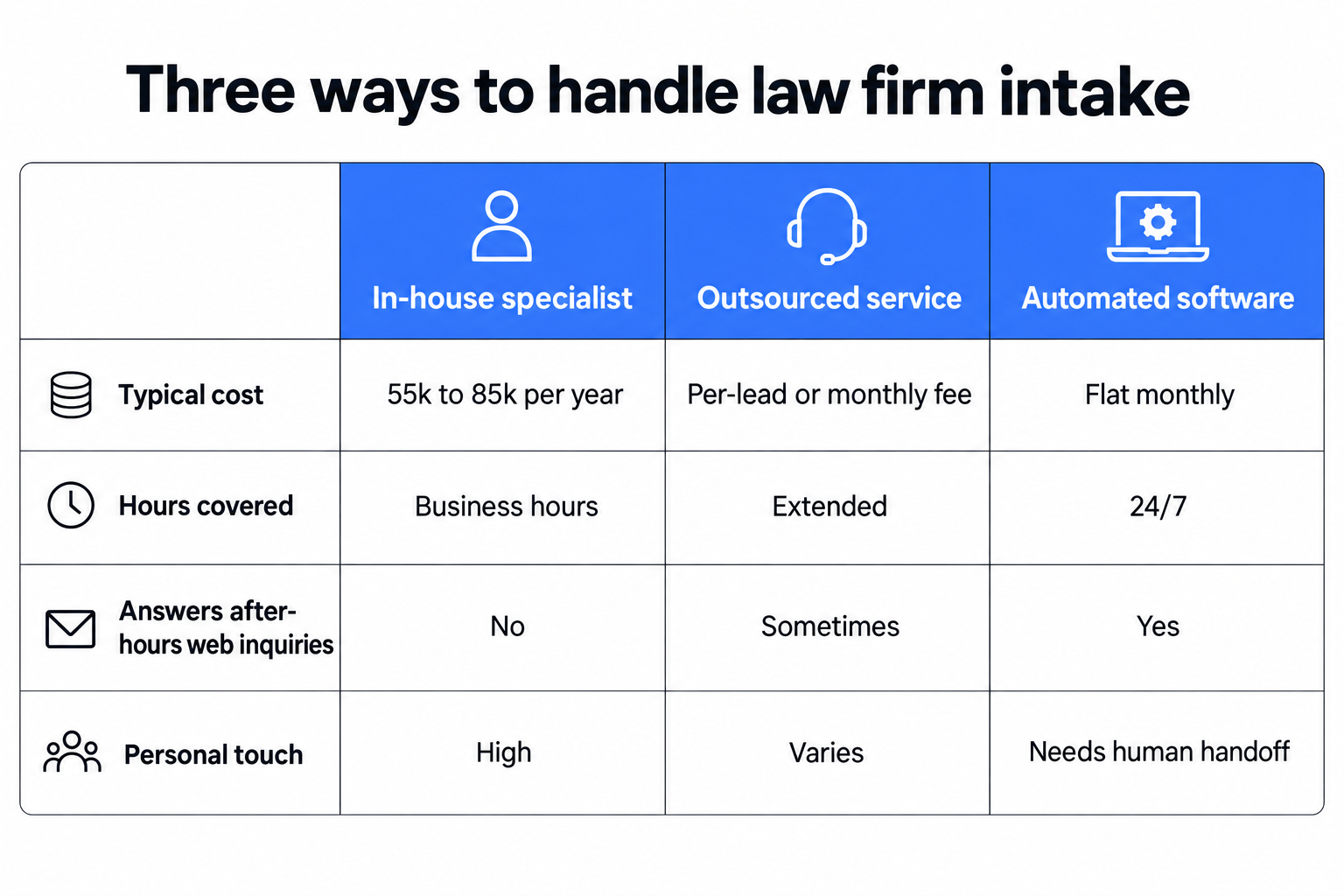
Hiring, outsourcing, and automating are the three real options
Once you accept that the role matters and that one person cannot cover every hour, you have three ways to fill it. Most firms end up with a mix.
| Option | What you get | The catch |
|---|---|---|
| Hire in-house | Full control, firm-trained, loyal to your brand | Costs $55k to $85k all in, covers ~40 hrs/week, turnover hurts, nights and weekends still open |
| Outsource to a service | Extended hours, trained staff, no hiring | Per-lead or monthly fees, less control over tone, scripts can feel generic, website chat often not covered |
| Automate the first touch | Instant replies 24/7, consistent questions, scales with volume | Needs good setup, best for the first response and qualifying, not for the human relationship later |
None of these is the whole answer by itself. A sharp in-house specialist handles the warm, high-value conversations and the sign-ups. A service or an automated tool like Burt covers the hours and the overflow your human cannot, answering website inquiries and texts the moment they come in, asking the same qualifying questions every time, and handing a clean file to your team in the morning. The lesson most firms learn the hard way is that the choice is rarely "human or machine." It is "which parts of the job does each do best."
For a deeper breakdown of the tradeoffs, see in-house specialist vs outsourced service vs AI. And if you want the full picture of how modern intake works end to end, read the complete guide to AI intake.
How to decide for your firm
Start with a week of honest data. Log every inquiry: when it came in, how fast you answered, and whether it signed. Most owners are surprised by how many land after hours and how many wait days for a reply.
Then match the fix to the gap:
- Steady daytime volume, cases slipping at night? Keep your specialist and add 24/7 coverage for the off-hours.
- One person drowning at peak times? Automate the first response so nothing waits in line.
- No intake person at all? Automating the first touch catches cases while you decide whether to hire.
Frequently asked questions
What is an intake specialist at a law firm? An intake specialist is the person who handles new client inquiries from first contact to the point an attorney takes over. At a personal injury firm, that means answering website chats, forms, and texts, qualifying whether the case fits, collecting the details and evidence, showing empathy to someone who is hurting, and booking the next step. They are the front door to the firm.
How much does a law firm intake specialist make? It varies by market and experience. In 2026, ZipRecruiter reports a national average near $43,000 a year, while Salary.com reports closer to $70,000 depending on seniority and location. Big-city and senior roles pay more. With taxes, benefits, and software, one full-time seat usually costs a small firm $55,000 to $85,000 all in.
Is it better to hire an intake specialist in-house or outsource? Both work, and many firms do both. In-house gives you control and a firm-trained voice for high-value conversations. Outsourcing or automating fills the hours one person cannot cover, like nights, weekends, and busy spikes. Start by measuring when your inquiries actually arrive, then cover the gaps your current setup misses.
Can intake be automated without losing the human touch? The first response and the qualifying questions automate well, and doing so means nobody waits. The relationship, the judgment calls, and the sign-up still belong to a person. The firms that get this right automate the speed and keep the humans for the moments that need a human.
The real metric is how fast a scared person hears back
Intake is not a back-office chore. It is the moment someone decides whether your firm is the one that will help them. Get the first response fast and human, every hour of every day, and more of those moments turn into cases.
If you want more plain-English guides on running a tighter personal injury practice, from intake to growth, subscribe to our newsletter. We send the useful stuff and skip the fluff.