Someone just rear-ended on the freeway opens your website at 9:40 on a Sunday night. They fill out your contact form, hit send, and wait. Nobody reads it until Monday at nine. By then they have signed with the firm that answered first. That inquiry was a signed case, and it slipped away while your office was dark.
That is the real intake problem, and it is why so many firm owners are rethinking how they staff it in 2027. You have three ways to cover it: hire a personal injury intake specialist in-house, outsource to an intake service, or put software on the first response. Each one changes your cost, your speed, and whether anyone answers at night. This guide lays out the tradeoffs so you can pick without guessing.
Speed is the whole game, and the numbers are brutal
The research on response time has been consistent for over a decade. A Harvard Business Review study of 2,241 US companies found the average first response to a web lead was 42 hours. Firms that answered within five minutes were 100 times more likely to reach the lead and 21 times more likely to qualify it than firms that waited 30 minutes. Velocify's analysis of roughly 3.5 million leads found that responding within a minute lifted conversion by 391%.
Injured people do not wait. A large share of personal injury inquiries come in after hours, and the person who sends one is shopping. Most of them sign with whoever responds first. So the question is not really "who handles intake." It is "who answers the Sunday-night form before your competitor does."
The three options, side by side
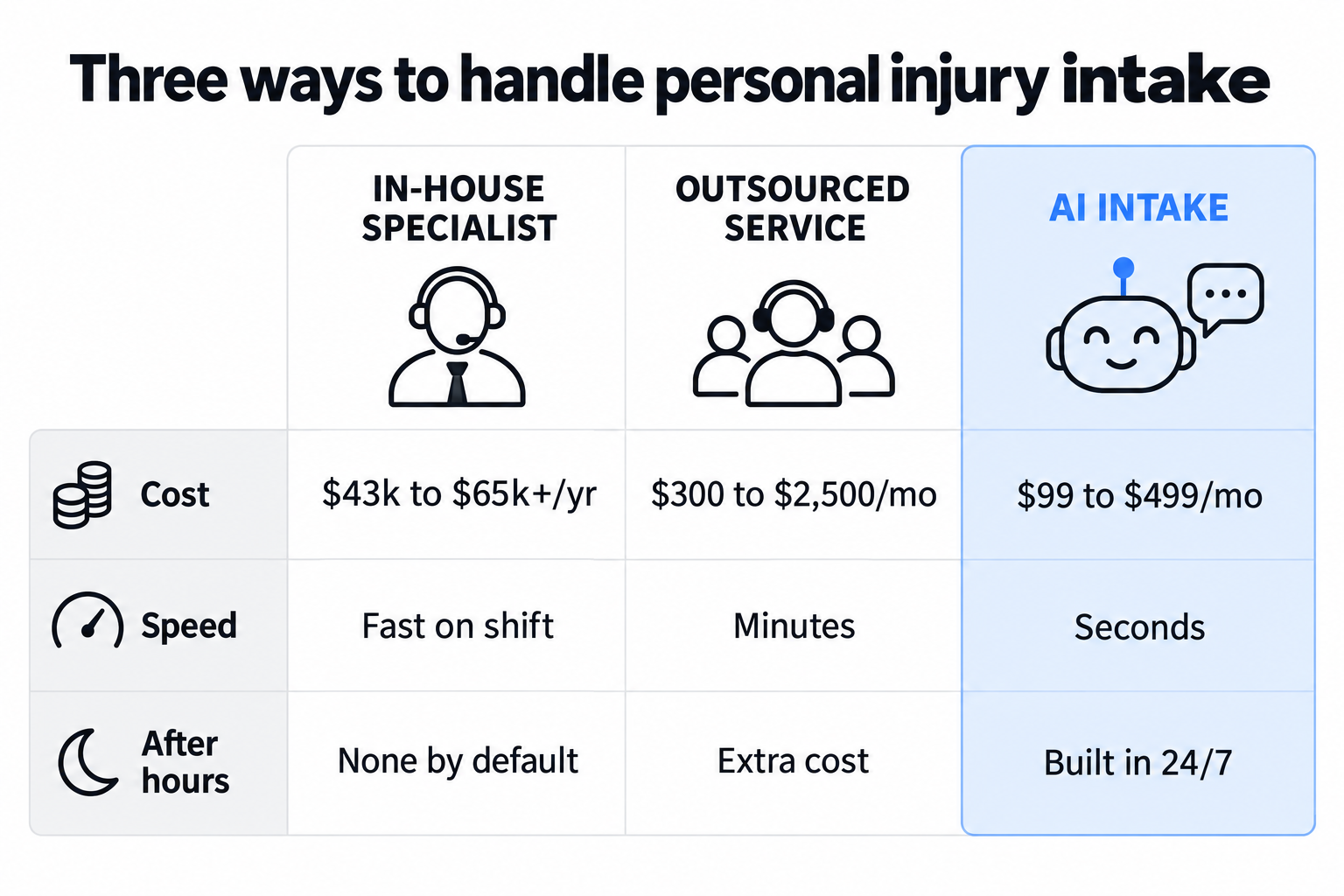
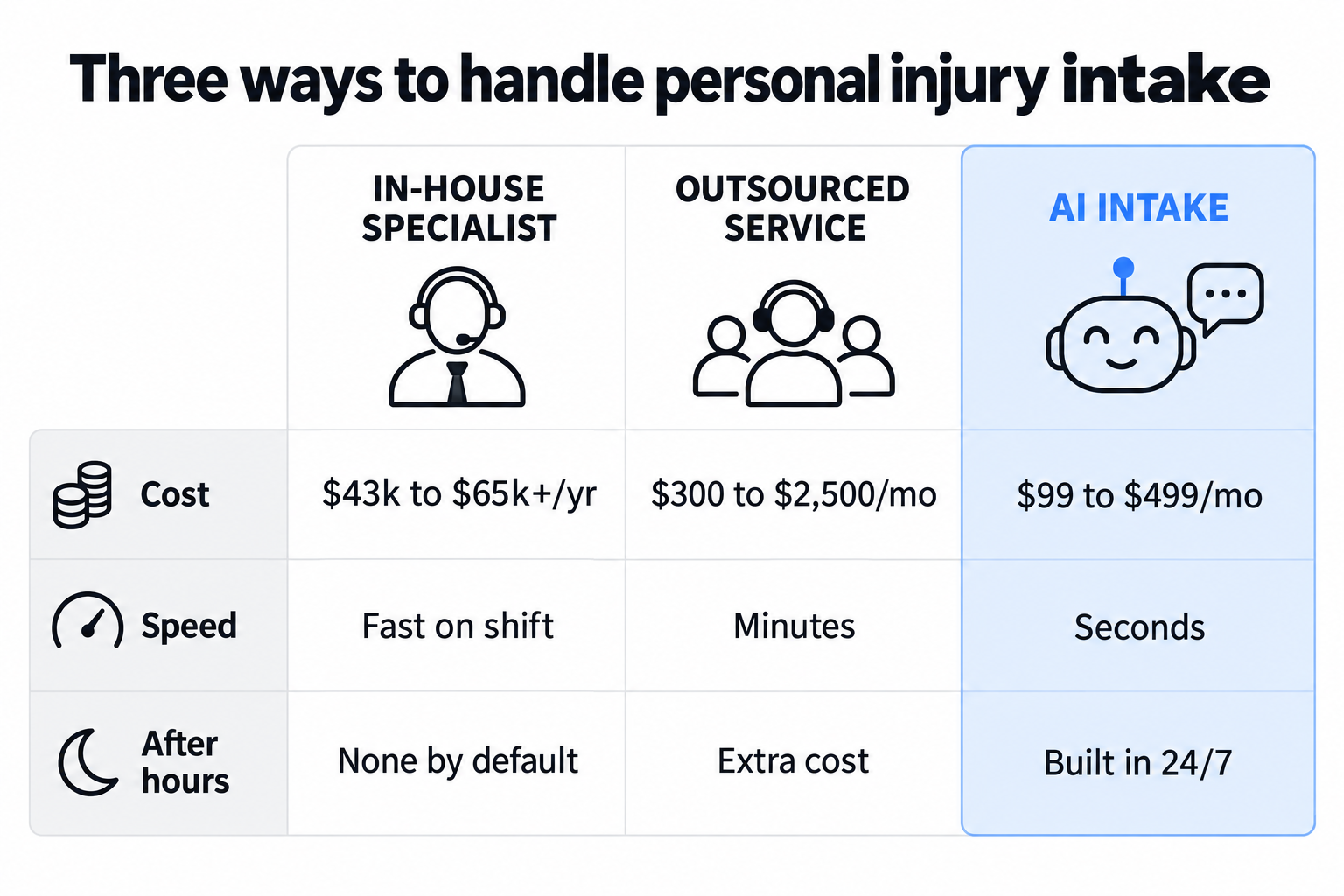
Here is how in-house, outsourced, and AI stack up on the things that decide whether you win the case.
| In-house specialist | Outsourced service | AI intake | |
|---|---|---|---|
| Typical cost | $43,000 to $65,000+ salary plus benefits | $300 to $2,500/mo retainer | $99 to $499/mo platform fee |
| Speed to first response | Fast while on shift | Minutes, during covered hours | Seconds, instant |
| After-hours coverage | None, unless you pay for a night shift | Extra cost for 24/7 | Built in, 24/7 |
| Consistency | Varies by person and mood | Script-driven, trained on legal intake | Same every time |
| Spanish intake | Only if you hire for it | Depends on vendor | Built in with the right tool |
| Best for | Firms with steady daytime volume | Firms wanting trained humans without payroll | Firms losing after-hours website leads |
Cost figures come from salary aggregators and published vendor pricing. Treat them as ranges, not promises, and always check current rates for your market.
An in-house specialist gives you control and a payroll bill
Hiring your own intake specialist means someone who knows your firm, your practice area, and your tone. They can read a caller, build rapport, and handle a messy fact pattern in a way no script fully matches.
The cost is the catch. The national average pay for a law firm intake specialist runs around $43,000 a year, and personal injury firms often pay more, with reported averages above $65,000 for the role. Add benefits, payroll tax, training, and a desk, and the real number climbs past $50,000 to $70,000 before you count a single signed case. One person also covers one shift. Nights, weekends, and holidays stay dark unless you hire two or three more, and that is where most website inquiries land.
In-house works when you have steady daytime volume and want a human who owns the relationship. It does not solve the after-hours gap on its own.
An outsourced intake service buys you trained humans without the payroll
Personal injury intake outsourcing hands the work to a company whose whole job is answering for law firms. You get trained staff, a script tuned to legal intake, and someone else managing turnover and scheduling.
Published 2026 pricing ranges widely. Business-hours plans start around $250 to $600 a month for a set number of minutes or calls. True 24-hour coverage runs higher, often $600 to $1,500 a month or more, and per-minute plans bill $1.50 to $4.00. A dedicated outsourced specialist typically runs $1,500 to $3,000 a month, which is still less than a comparable in-house hire once you load in benefits.
The tradeoffs are real. Per-minute billing means a chatty inquiry costs more. The staff answering for you also answer for other firms, so the depth of knowledge is thinner than an in-house hire. And many services were built for phone calls, not for the website form someone submits at midnight.
AI intake answers the website inquiry the second it arrives
The newest option puts software on the first response. An AI intake specialist for injury law answers the person who lands on your website, by chat and by text message, the moment they reach out, day or night, in English or Spanish. It asks the qualifying questions, captures the facts, and hands off to a human on your team when the matter needs one.
This is where the after-hours math flips. The 9:40 Sunday inquiry gets a real answer in seconds instead of sitting until Monday. Burt is one tool built for this: it answers website chat and text 24/7, works in English and Spanish, captures photos and video of the injury during intake, and routes to a person when a human should take over. Other tools exist, and the fit depends on your volume and how much of intake you want automated.
AI is not a human, and some clients want a voice. The strongest 2027 setups pair the two: AI catches and qualifies every inquiry instantly, then a specialist, in-house or outsourced, takes the warm ones from there. For a closer look at how this differs from a traditional phone service, see our breakdown of AI intake versus an answering service.
A simple way to decide
Start with one number: how many inquiries do you lose outside business hours? If the honest answer is "I don't know," that is your first problem, and it usually means the number is high.
If your volume is steady and daytime, an in-house specialist may pay for itself. If you want trained humans without running payroll, an outsourced service fits. If you are bleeding after-hours website leads, put AI on the first response and keep a human for the handoff. Most growing firms land on a blend. For the full picture of how automated intake fits a PI practice, read our guide to AI intake for personal injury firms.
Frequently asked questions
What does a personal injury intake specialist actually do? They are the first point of contact for a potential client. They answer the inquiry, ask the qualifying questions (how the injury happened, when, whether there is insurance), capture the facts, and either book the consultation or route the matter to an attorney. The role lives or dies on speed and consistency, because the person reaching out is usually contacting other firms too.
Is outsourcing intake cheaper than hiring in-house? Often, yes, on paper. An outsourced service runs roughly $300 to $2,500 a month depending on hours and volume, while an in-house specialist costs $43,000 to $65,000 or more a year before benefits. The real comparison is coverage and conversion, not just cost. A cheaper service that misses the after-hours inquiry can cost you far more in lost cases than its monthly fee.
Can AI really handle personal injury intake, or does it lose the human touch? AI handles the speed and the first response well: it answers instantly, asks the right questions, and never sleeps. It does not replace the judgment and empathy of a person on a hard case. The practical answer for 2027 is to use AI to catch and qualify every inquiry, then hand the real ones to a human. You get the speed and the touch.
The case you win is the one you answer first
Intake is not a back-office chore. It is the moment you win or lose the client, and in personal injury that moment often happens at night, on your website, while your office is closed. Whether you hire, outsource, or automate, the test is the same: does someone get a real answer to that Sunday-night inquiry before your competitor does?
Subscribe for plain-English guides that help personal injury firms turn more inquiries into signed cases, sent straight to your inbox.