You finish a website, invoice the client, and start the month at zero again. The build was good, the client was happy, and your revenue graph looks like a row of teeth. Project work does that. You are only ever as stable as the next signed proposal, and the hunt for that proposal never ends.
The agencies that escape the hunt sell something clients pay for every month without a new quote. Lead generation is the cleanest version of that, because a client who gets leads every week renews without being asked. White-label lead gen lets you add it this quarter without building a system from scratch. Here is how the shift works and what it does to your numbers.
Recurring revenue is a different business than project work
The gap between a project agency and a retainer agency shows up in two places that matter at exit: how long clients stay, and what the business is worth.
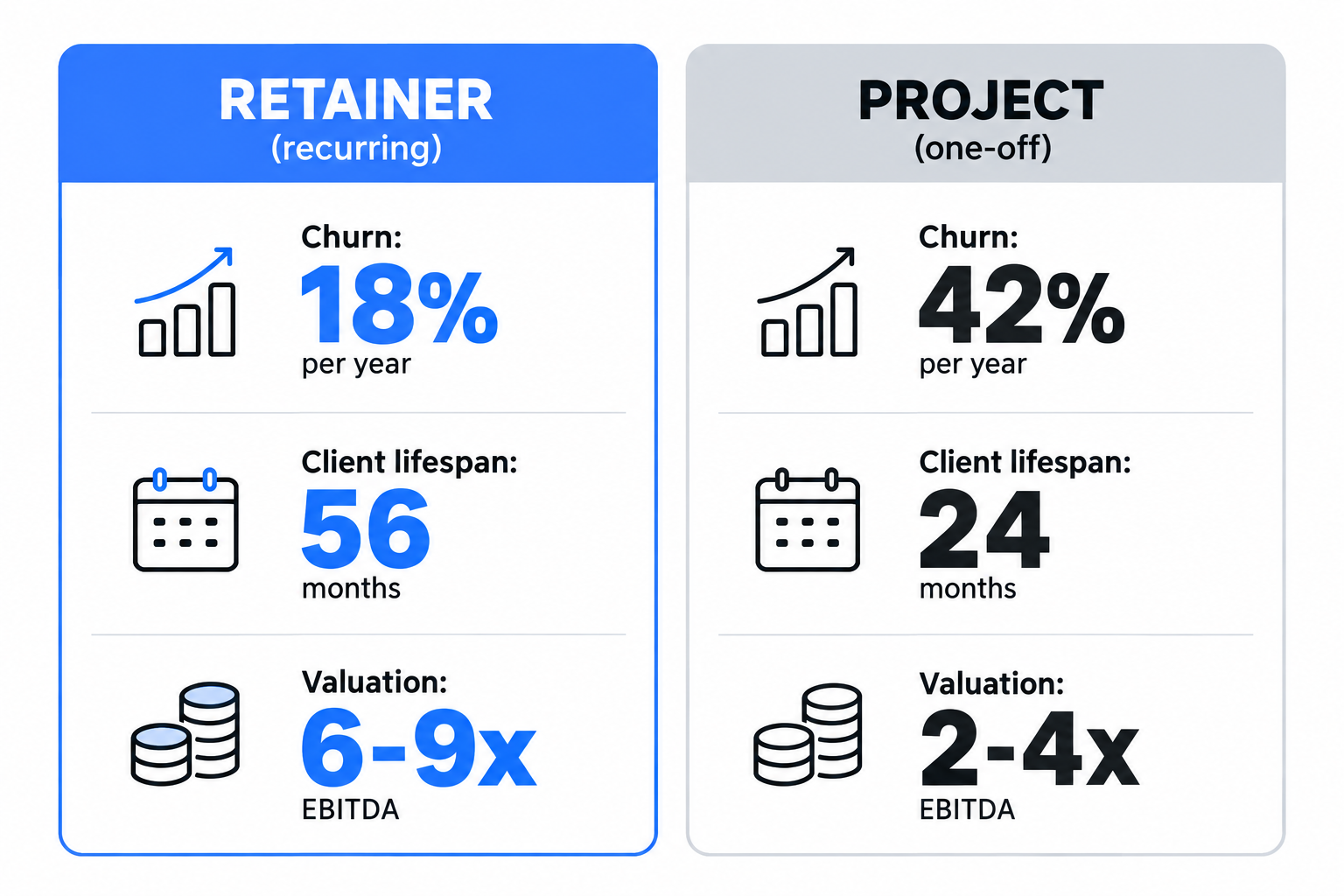
Retainer agencies churn around 18% of clients a year. Project shops churn about 42%. The average client lifespan tells the same story, 56 months on a retainer versus 24 months on project work. A retained client stays more than twice as long, which means you spend less of every year replacing the revenue you already earned.
The valuation gap is wider. A project-heavy generalist agency, under 30% recurring revenue, trades around 2x to 4x EBITDA. Push past 60% recurring and the range jumps to 6x to 9x. Recurring revenue businesses change hands at roughly 1.5x to 2x the multiple of project-based ones, because a buyer can predict the cash flow. The work you do is the same. The business you own is worth two to three times more.
Lead generation earns the retainer better than most services, because the client sees the output every week. A logo redesign is a memory by month two. A steady flow of booked calls is a reason to keep paying.
Build versus resell is a math problem, not a pride problem
You can build lead generation in house. You hire the outreach staff, buy the data and sending tools, learn deliverability, write the sequences, and manage the campaigns. It works, and plenty of agencies do it. It also takes months and a payroll commitment before the first client is served, and the first campaigns are where you learn the expensive lessons.
White-label lets you skip to the revenue. A specialist platform or partner runs the actual lead gen, the outreach, the ad campaigns, or the intake technology, and you resell it under your brand. The wholesale cost is low and the margin is immediate.
The numbers favor reselling at the start. White-label lead-gen platforms commonly cost $200 to $500 per month per client seat at wholesale, and some seats run $50 to $200. Agencies resell those at $300 to $1,500 and up, which puts gross margin on the software component as high as 85%. At a $3,000 monthly retainer against a $200 platform cost, the software piece alone runs near 93% margin. Build in house only once you have enough clients that owning the system beats renting it, which is a decision you make from a position of revenue, not hope.
What white-label lead generation actually includes
Lead generation is a category, not a product. The white-label market covers several distinct engines, and knowing which you are reselling keeps your promises honest.
Outbound outreach is the common one: a partner runs cold email or LinkedIn campaigns on your clients' behalf, books meetings, and hands them over. Paid-media lead gen runs ads to a landing page and delivers form fills or calls. Local lead gen builds ranking assets and routes the inbound to the client. And lead-capture technology sits on the client's own site and converts the traffic they already have into booked, qualified leads.
Price it the way the specialists do: a platform fee that recurs every month no matter the output, plus a performance layer tied to qualified meetings or leads delivered. The recurring fee protects your margin on slow months. The performance layer keeps the client feeling like you have skin in their results. Ten clients on a $3,000 retainer is $30,000 in monthly recurring revenue, and it renews on its own as long as the leads keep arriving.
One option worth knowing in this category is white-label AI intake. Instead of generating new traffic, it captures the leads a client already pays for, answering every inbound chat or form instantly, qualifying the person, and booking them before a competitor picks up the phone. Burt runs a partner program that lets an agency resell AI intake under its own brand for recurring commission, which is one way to add a lead engine without building or staffing it. It sits alongside outreach and paid media as a service you can offer, not a replacement for them.
Keeping the margin you started with
The margin on day one is not the margin you keep unless you protect it. Three habits do that.
Hold the client relationship. The partner delivers the leads, you deliver the strategy, the reporting, and the monthly call. An agency that becomes a silent pass-through gets renegotiated down to the platform cost, because the client can see there is nothing else to pay for. Report on the outcome the client cares about, which is booked business, and the fee defends itself.
Match the engine to the client. Outbound suits a client selling to other businesses. Paid media suits a local service firm with budget and no time. AI intake suits a client who already gets inquiries and loses them to slow follow-up. Sell the wrong engine and the leads disappoint, the client churns, and you are back in the project hunt you left.
Frequently asked questions
What is white-label lead generation? A specialist partner or platform generates or captures leads for your clients, and you resell that service under your own brand. The partner stays invisible, you keep the contract and the client relationship, and you pay a wholesale rate while setting your own retail price.
Is reselling lead generation more profitable than building it in house? At the start, yes. White-label platforms run $200 to $500 per client seat wholesale, resell for $300 to $1,500 and up, and reach gross margins near 85% to 93% on the software with no upfront build or payroll. Building in house makes sense later, once your client volume justifies owning the system.
Why does recurring lead-gen revenue raise an agency's value? Retainer revenue churns far less than project work, around 18% a year versus 42%, and buyers pay a premium for predictable cash flow. Agencies above 60% recurring revenue trade around 6x to 9x EBITDA, versus 2x to 4x for project-heavy shops.
The move from project work to recurring revenue is the difference between hunting every month and compounding every month. Lead generation is the service clients most want to keep paying for, and white-label is the fastest way to start offering it.
We publish a new agency growth playbook every week, from pricing to packaging to the services worth adding. Subscribe and get the next one in your inbox.