Most agency revenue leaks out the bottom. You win a website build, a logo refresh, a campaign, and three months later the client is gone and you're prospecting again. Recurring services are the fix, and in 2027 the newest one has almost no competition yet: getting clients cited inside AI answers.
Here's the opening. Traffic from AI search engines to websites grew 16x between 2024 and 2026, and ChatGPT alone sends about three-quarters of all AI referral traffic. Clients already feel it. They're watching prospects ask ChatGPT and Perplexity for recommendations, and they don't understand why they never come up. You can sell the answer to that question every month.
AI search optimization is a monthly service, not a one-time fix
Answer engine optimization (AEO) and generative engine optimization (GEO) earn your client citations inside ChatGPT, Perplexity, Gemini, and Google AI Overviews. The work never finishes, which is the point. Models update, competitors publish, and visibility that was earned in March erodes by July without maintenance. That's a retainer, not a project.
The market agrees. Across agencies selling it, 68% price AEO and GEO as a monthly retainer, and the median retainer runs $6,850 a month. You don't need a $6,850 client to start. Entry retainers for basic AI-visibility tracking plus foundational optimization sit around $1,800 to $2,500, and most agencies sell the service as a surcharge on an existing SEO contract rather than a separate pitch.
White-label means you sell it, a partner delivers it
You don't need to hire a GEO specialist to offer this. A white-label partner runs the delivery under your brand, and you own the client relationship, the reporting, and the margin.
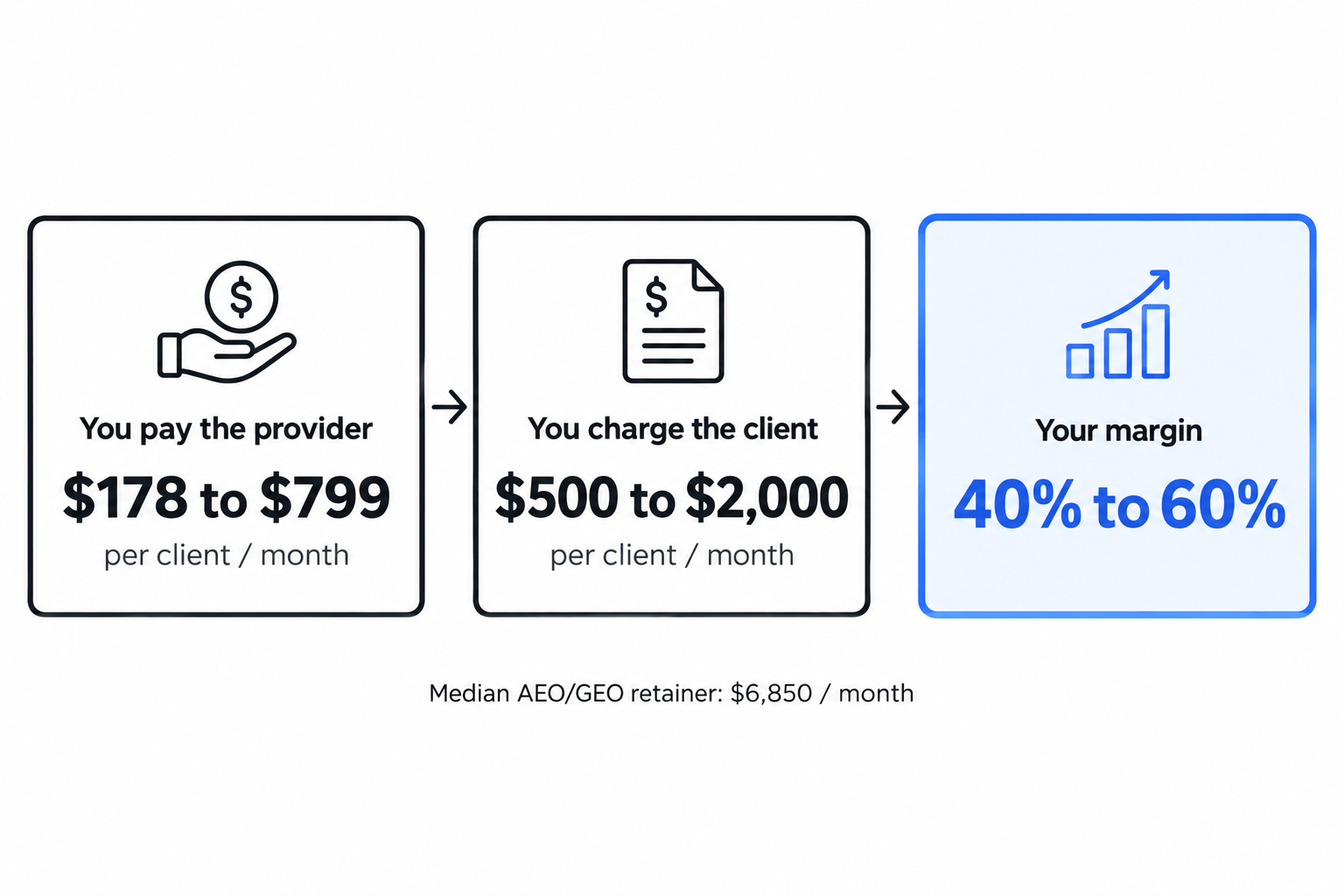
The economics are clean. White-label AEO/GEO providers charge roughly $178 to $799 per client per month depending on scope. Agencies then bill $500 to $2,000 per client per month for AI visibility, usually as a premium add-on, at a standard margin of 40% to 60% on delivery cost. The client pays for an outcome. You pay for execution. The spread is the recurring revenue you were missing.
What goes in the deliverable
A white-label AEO/GEO service that holds a retainer covers five layers. Sell these as the scope, no matter who executes them.
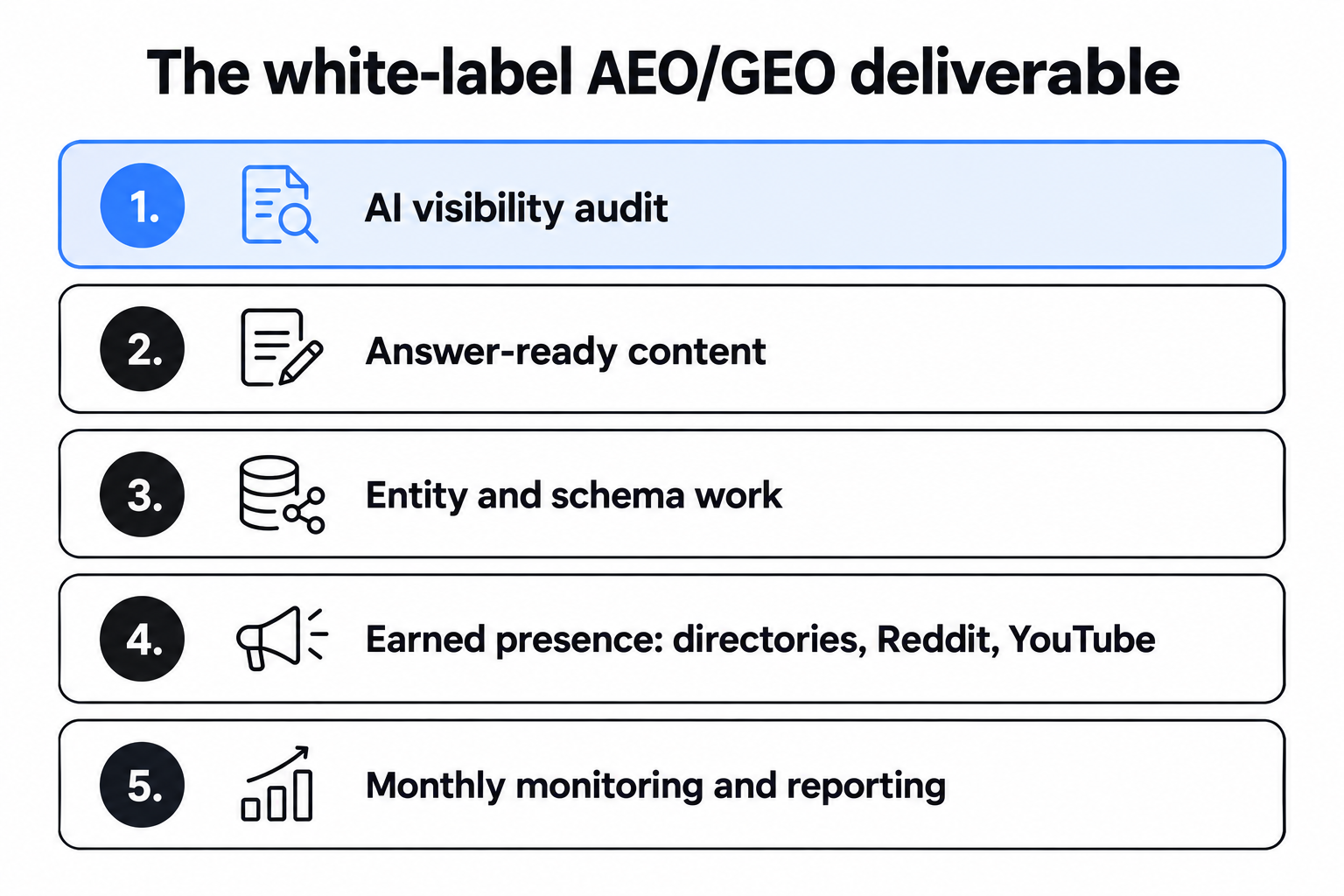
AI visibility audit. A baseline of where the client gets cited today across ChatGPT, Perplexity, and AI Overviews, and where competitors beat them. This doubles as your sales tool, a one-time audit runs $1,500 to $5,000, or you give it away to close the retainer.
Answer-ready content. Pages and FAQs restructured so the first two sentences answer the question directly, the format the engines quote.
Entity and schema work. Clear definitions of the brand, people, and services, plus FAQPage, Organization, and industry schema that tells engines what the page is.
Earned presence. Placements and mentions on the third-party sources the engines over-cite, directories, Reddit, YouTube, editorial coverage, since brand-owned pages alone rarely win the citation.
Monitoring and iteration. The monthly prompt tracking that proves the work and resets each cycle.
The report is the retention mechanism
Clients churn when they can't see what they're paying for. AI visibility is invisible by default, so your report has to make it concrete. Run the prompts a real buyer would use, in the client's category and city, across the major engines. Log whether the client gets named, cited, or ignored, and track that share-of-answer month over month against named competitors.
That single number, "you now appear in 7 of 12 target prompts, up from 2," is what renews the contract. It also surfaces the next thing to fix, which keeps the retainer productive instead of idling.
Pricing it so it sticks
Three moves keep the margin healthy. Lead with the audit, paid or free, so the client sees the gap before you quote the fix. Bundle AEO/GEO onto an existing retainer as an add-on rather than a standalone line, which raises account value without a fresh sales cycle. Tier it, a starter tracking package, a full optimization retainer, an enterprise build, so a client can grow inside your service instead of leaving for a bigger shop.
One lesson from agencies running this at scale: visibility you can't convert is a vanity metric. An AI engine sends a client a motivated lead, and a slow intake process hands that lead to whoever answers first. Some agencies now white-label AI intake alongside AEO, so the AI-referred lead actually books, which is the model behind Burt's partner program. Visibility gets the lead to the door. Intake decides whether it signs.
Frequently asked questions
What is a white-label AEO service? A white-label AEO service is answer engine optimization delivered by a specialist partner under your agency's brand. You sell and report it to the client as your own; the partner executes the audit, content, schema, and monitoring behind the scenes.
How much can an agency charge for AI search optimization? White-label AEO/GEO delivery costs an agency roughly $178 to $799 per client per month. Agencies commonly bill clients $500 to $2,000 per month for it, often as an add-on to an SEO retainer, at a 40% to 60% margin. The median standalone AEO/GEO retainer across the market is $6,850 a month.
Is AEO and GEO worth adding in 2027? For most client-service agencies, yes. AI referral traffic grew 16x from 2024 to 2026 and keeps climbing, the service carries high margins, almost no agency offers it well yet, and it renews monthly. The white-label route lets you sell it before you can staff it.
The agencies that add AI search now will own the category while it's still uncontested, and the recurring revenue compounds the same way SEO retainers did a decade ago. We cover the services worth reselling, how to price them, and how to win legal clients, every week.
Subscribe for the agency growth playbook: new recurring services, real pricing data, and the tactics that build retainer revenue.