It is 11pm on a Saturday. Someone got hurt in a wreck that afternoon, and they are scrolling their phone from an urgent care waiting room. They find your website. They fill out the contact form. They write a few shaky sentences about what happened and hit submit.
Then nothing.
Your office is closed. The form drops into an inbox nobody will open until Monday morning. By the time someone on your team reads it, that injured person has already filled out three more forms, and one of those firms answered in minutes. The case is signed. It was never really yours to lose on the merits. You lost it on the clock.
That is a missed lead. Not a bad case, not an unqualified one. A case you could have signed, gone because the website went quiet when it mattered.
Slow beats absent, and both lose
Most owners picture a missed lead as a form that never arrives. The expensive version is worse. The form arrives, sits, and goes cold while you sleep.
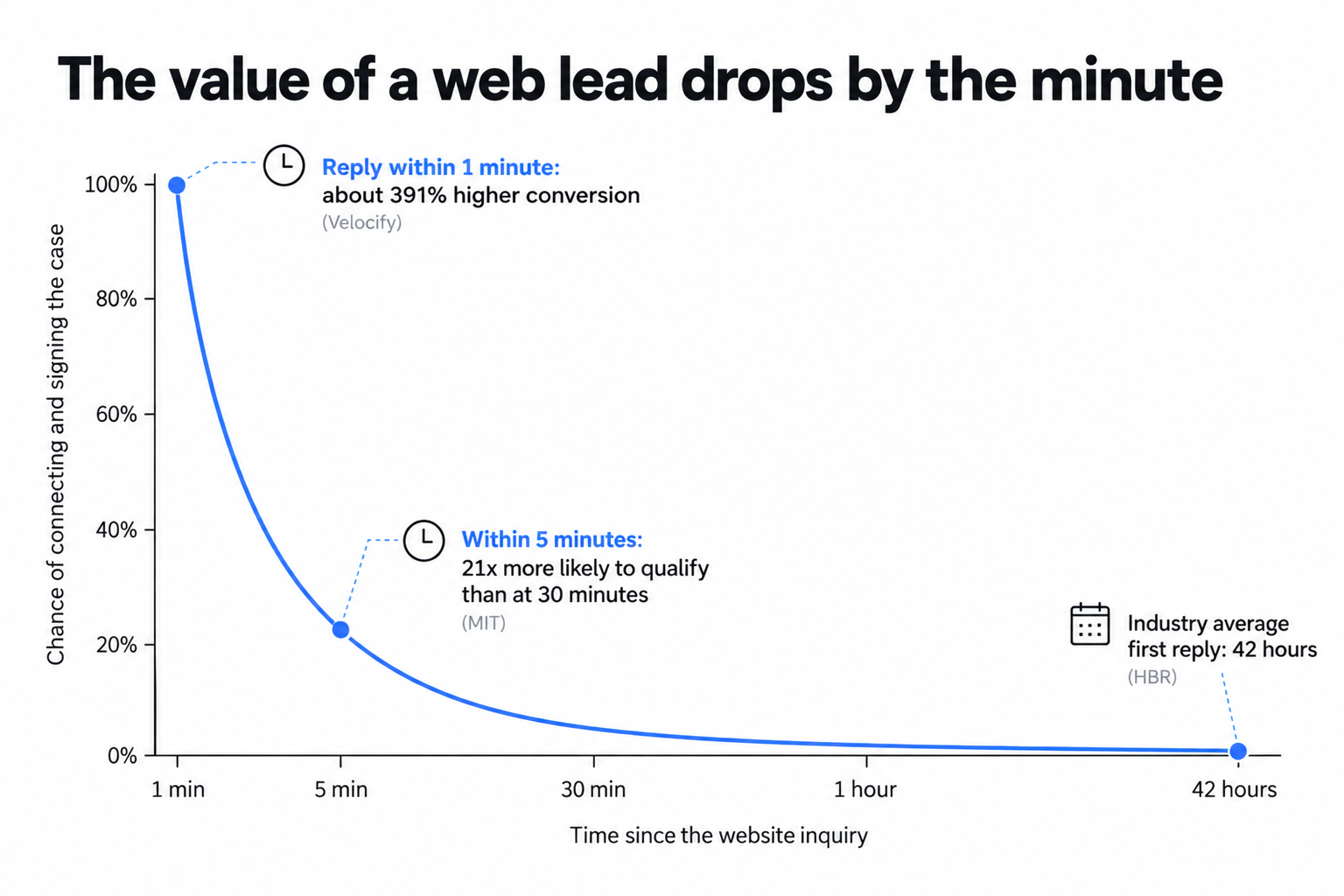
A 2011 Harvard Business Review study ("The Short Life of Online Sales Leads") audited 2,241 companies on how fast they answered a web lead. The average first response was 42 hours. Nearly a quarter of companies, 23 percent, never responded at all. These were businesses that paid to generate the lead in the first place, then let it rot in an inbox.
Forty-two hours. For an injured person deciding who will handle the biggest legal problem of their life, forty-two hours is forever. They are not waiting for you. They are talking to whoever talks back.
The window is minutes, not hours
Here is the part that should sting. The advantage of answering fast is not small, and it closes almost immediately.
Research from MIT's James Oldroyd, run with InsideSales.com across more than 15,000 leads, found that contacting a web lead within five minutes makes you 21 times more likely to qualify it than waiting just 30 minutes (Oldroyd, 2007). Not thirty hours. Thirty minutes. The difference between a five-minute reply and a half-hour reply is the difference between a live conversation and a form that has already gone cold.
Push it further and the numbers get louder. An analysis of roughly 3.5 million leads by Velocify (Leads360) found that answering within one minute lifted conversion by about 391 percent compared with slower responses. Speed is not a nice-to-have in intake. It is most of the game.
So when your contact form sits untouched from Friday night to Monday, you are not a little behind. You are on the wrong side of a 21x and a 391x gap, every single time.
The cost compounds quietly
One missed case is easy to shrug off. You did not see it, so it does not feel like money leaving your pocket. That is exactly why it is dangerous.
Think about your own numbers instead of a made-up average. How many website inquiries land outside business hours in a month? Count the nights, the weekends, the holidays, the lunch hours. For most firms that is not a handful. Now assume the research is right and most of those go to whoever replied first. That stack of silent forms is not nothing. It is a second pipeline you are funding and never collecting.
You already paid for every one of those leads. You paid in ad spend, in SEO, in referral relationships, in the years of reputation that made someone type your name into a search bar at midnight. The lead showed up. The intake is where it fell through.
Speed is an operations problem, not a hiring problem
The instinct is to throw people at it. Staff the evenings. Ask an associate to check the inbox from home. Hire a weekend person.
That helps a little and burns out fast. People sleep, take vacations, and miss the 2am form while they are off the clock. A human-only intake desk cannot cover a 24/7 web form without a rotation most small firms cannot afford.
The firms winning the speed game treat it as a system, not a staffing heroics project. The job is simple to state and hard to do by hand: answer every website inquiry in seconds, any hour, in the language the person wrote in, and get a real human involved before the conversation goes cold.
There are a few ways to close the gap. Some firms staff a live chat team across shifts. Some route web inquiries to an on-call attorney by text. Some use an AI intake tool like Burt to answer on the website and by text instantly, then hand off to a person when it counts. The right choice depends on your volume and your budget. The wrong choice is the one most firms are living with now, which is no system at all after 6pm.
Whatever you pick, measure one thing: your lead response time. If you do not know how many minutes pass between a form hitting your site and a real reply going out, that is the first number to find. You cannot fix a gap you are not watching.
Frequently asked questions
What counts as a missed lead for a law firm? It is any potential client who reached out and did not get a timely response, so they hired someone else or gave up. For a personal injury firm that usually means a website inquiry or contact form submitted after hours that sat unanswered until the next business day. The person was interested and qualified. The delay, not the case, lost it.
How fast do I actually need to respond to a web lead? Faster than feels reasonable. The MIT study (Oldroyd, 2007) found a five-minute reply makes a lead 21 times more likely to qualify than a 30-minute reply, and Velocify's analysis of about 3.5 million leads found that answering within one minute lifted conversion by roughly 391 percent. The practical target is minutes, not hours, and the same standard applies at midnight as at noon.
Does responding faster really win cases, or just more conversations? More conversations are how you get more signed cases. An injured person comparing firms tends to sign with the one that engaged first and made them feel handled. The Harvard Business Review audit found an average first response of 42 hours and 23 percent of companies never replying, which is the exact gap a fast-responding firm walks into and takes.
I cannot staff my intake 24/7. What are my options? Most firms close the after-hours gap with a system rather than more hiring. Options include a shifted live chat team, an on-call attorney reachable by text, or an AI intake tool that answers on the website and by text instantly and hands off to a person. Start by measuring your current lead response time, then pick the approach that covers nights and weekends without burning out your team.
The leak is fixable, and worth watching
You are not losing cases because your lawyering is weak. You are losing them in the quiet hours when a hurt person reached out and your website had nothing to say back. That is a fixable problem, and the first step costs nothing: find out how long your firm actually takes to answer a web inquiry, especially after dark.
We write about speed to lead, intake, and the operations that turn website traffic into signed cases, grounded in real data and real firm workflows. If you want the next breakdown in your inbox, subscribe to the blog.
Related reading: Speed to lead: the first five minutes decide the case and AI intake vs. a legal answering service.