
You take any client who pays. A dentist one month, a SaaS startup the next, a restaurant after that. Every project starts from zero because nothing you learned on the last one transfers. You compete on price, win on price, and lose on price when someone cheaper shows up. Your margins stay thin and your clients leave inside a year.
A marketing agency niche fixes most of that. Pick one vertical, learn it deeper than any generalist can, and the whole economics of your business change. The numbers back it, and legal is one of the richest niches on the board.
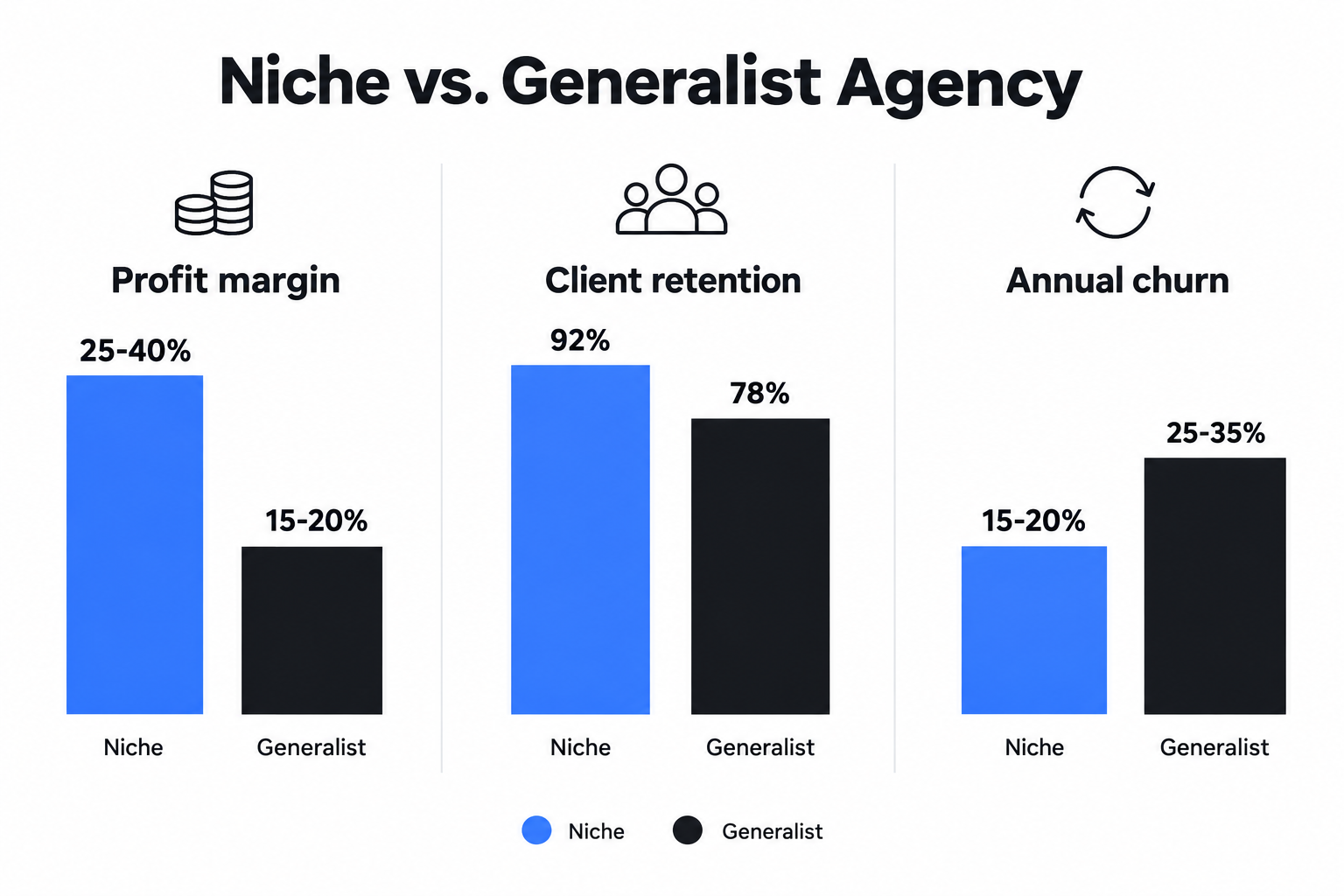
Specialist agencies out-earn generalists on every line that matters
Specialization is not a branding exercise. It moves profit.
Specialist agencies run 25-40% margins. Generalists sit at 15-20%, according to 2025 agency benchmark data. Retention splits the same way: niche agencies keep 92% of clients while generalists keep 78%, and generalist churn runs 25-35% a year against 15-20% for the specialists. One study of healthcare-focused agencies measured average client tenure at 4.7 years, versus 2.1 years for generalists serving the same healthcare clients.
The reasons are plain. When you serve one vertical, you stop rebuilding from scratch. Your playbook, your ad accounts, your reporting, your case studies all compound. You charge more because you walk in already knowing the client's business. You spend less winning each new account because one happy client sends you the next.
Legal is one of the best niches for a marketing agency
Pick a vertical with money, urgency, and repeat need. Legal has all three.
The U.S. legal services market runs past $350 billion. Law firms advertise hard to feed it: legal advertising in the United States is projected to pass $3 billion in 2026, and trial-lawyer ad spending alone hit $2.5 billion, up 39% between 2020 and 2024. Firms treat marketing as a core cost of doing business, not a line to trim when things get tight.
A single client is worth far more than in most verticals. A law firm does not buy one campaign and vanish. It needs leads every month the doors are open, which makes a legal client a multi-year relationship if you deliver. The client lifetime value is high enough that one retained firm can anchor an entire book of business.
Personal injury is the sweet spot inside legal
Not all legal work pays the same. Personal injury is where the budgets, the urgency, and the margins concentrate.
The U.S. personal injury market reached about $61.7 billion in revenue in 2025 and keeps climbing. Roughly 60,000 PI firms compete for cases, and they pay to win. A click on a personal injury keyword in Google Ads averages near $196, and top metro terms like "car accident lawyer near me" push past $300 and $500. Cost per lead runs $312 to $512 depending on case type.
Those numbers look insane until you see the other side of the ledger. A signed case pays the firm a contingency fee of 33 to 40% of the settlement, and a serious case settles for tens or hundreds of thousands of dollars. One won case covers a lot of expensive clicks. That math is why PI firms spend 5 to 15% of gross revenue on marketing, with an industry average around 9.3% in 2026, up from 7.8% two years earlier.
For an agency, that combination is the dream: a client with a big budget, a clear return on every lead, and a permanent reason to keep spending. Add bilingual demand in Spanish-speaking markets and you have an edge most competitors never build.
How to reposition your agency into the legal niche
You do not need to fire every client Monday morning. You need a direction and six months of discipline.
Start by picking your lane inside legal. Personal injury, family law, criminal defense, and estate planning behave like different industries. PI rewards speed and lead volume. Go narrow.
Rebuild your proof around that lane. Turn your two best legal results into case studies that speak a lawyer's language: cost per signed case, intake response time, cases per month. Rewrite your site so a PI owner lands on a page about PI, not a generalist menu.
Learn the client's real problem, which is rarely traffic. Most PI firms generate leads and then lose them. More than 40% of leads go cold in the first hour because nobody answers fast enough. An agency that fixes the leak after the click, not only the click, becomes impossible to fire. One way agencies add that layer without building it is a partner program like Burt's, which white-labels AI intake so the firm answers every lead in seconds and the agency books recurring revenue on top of the ad retainer.
Then say no. The hardest part of a niche is turning down the dentist who emails next week. Every off-vertical client you take slows the compounding that makes specialization pay.
Frequently asked questions
What is the best niche for a marketing agency? The best niche has three traits: clients with real budgets, an urgent and recurring need, and high lifetime value. Legal fits all three, and personal injury sits at the top because PI firms spend heavily on ads and earn large contingency fees per signed case. Healthcare, home services, and financial services are other strong options.
Is niching down risky if the vertical slows? Concentration carries some risk, but the data favors specialists anyway: higher margins, lower churn, and longer client tenure. You can reduce the risk by picking a large vertical like legal, which has roughly 60,000 PI firms alone, and by serving more than one geographic market within it.
How long does it take to reposition a generalist agency? Plan for six to twelve months. The fast parts are your website and positioning. The slow parts are building vertical case studies, earning referrals inside the niche, and letting off-vertical clients churn off naturally as new specialized clients replace them.
A niche is a decision you make once and then defend every week. Pick the vertical with the richest economics, learn it cold, and let the margin and retention gap compound in your favor.
We break down how to win and keep law-firm clients every week, with the real numbers behind legal marketing. Subscribe and get the next playbook in your inbox.