A Spanish-speaking mother gets rear-ended on a Sunday night. Her shoulder is wrong. She finds your firm, opens your website, and sees an intake form in English only. She closes the tab and tries the next firm. You never knew she was there.
That is the quiet leak in most personal injury practices, and bilingual intake for personal injury firms is how you close it. Not a translated PDF. Not a voicemail box that promises someone will call back Monday. A real path for a hurt Spanish-speaker to tell you what happened, in Spanish, the minute they land on your site. In 2027 that path decides who signs the case.
The Spanish-speaking market is too big to treat as an edge case
Start with the size of what you are ignoring.
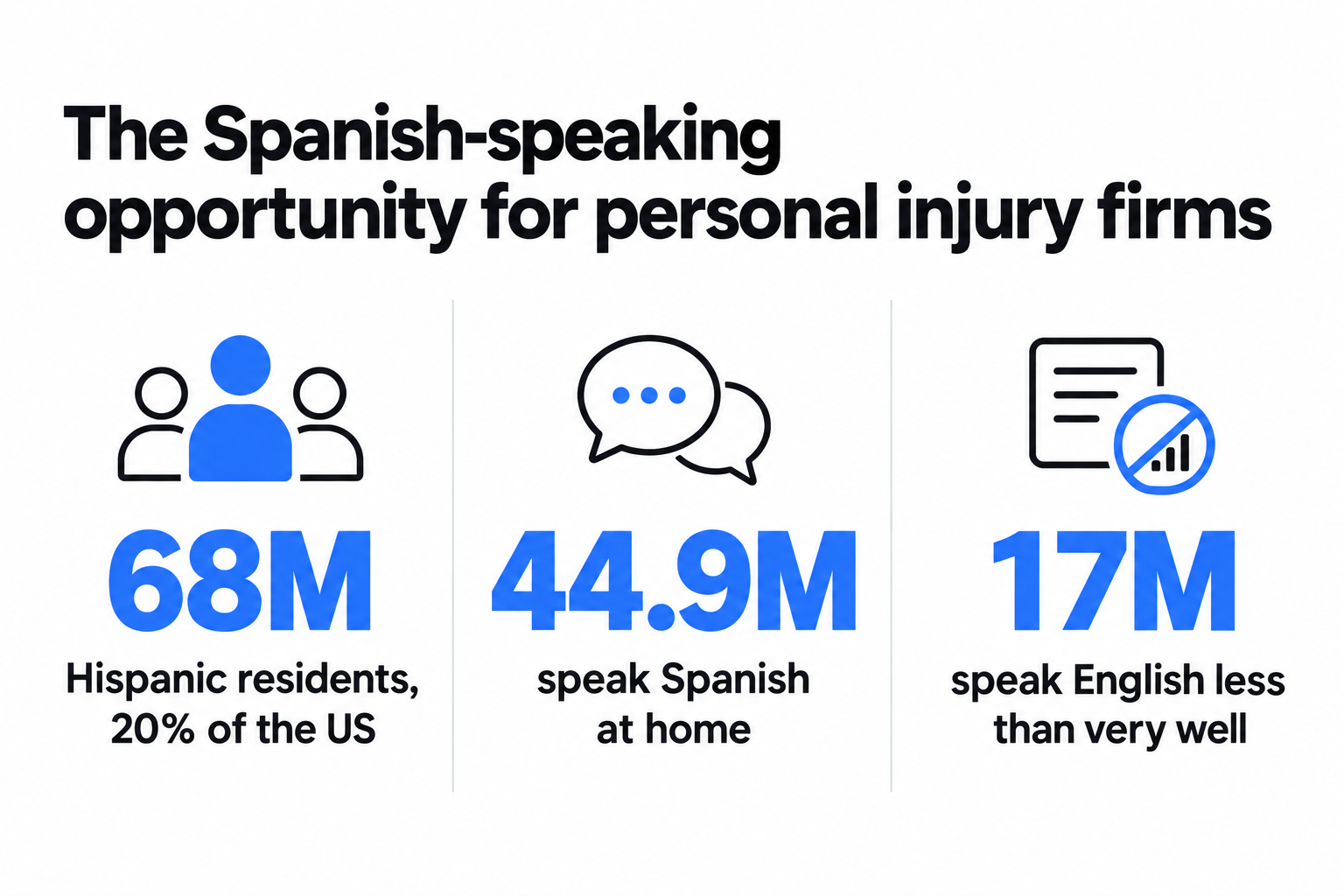
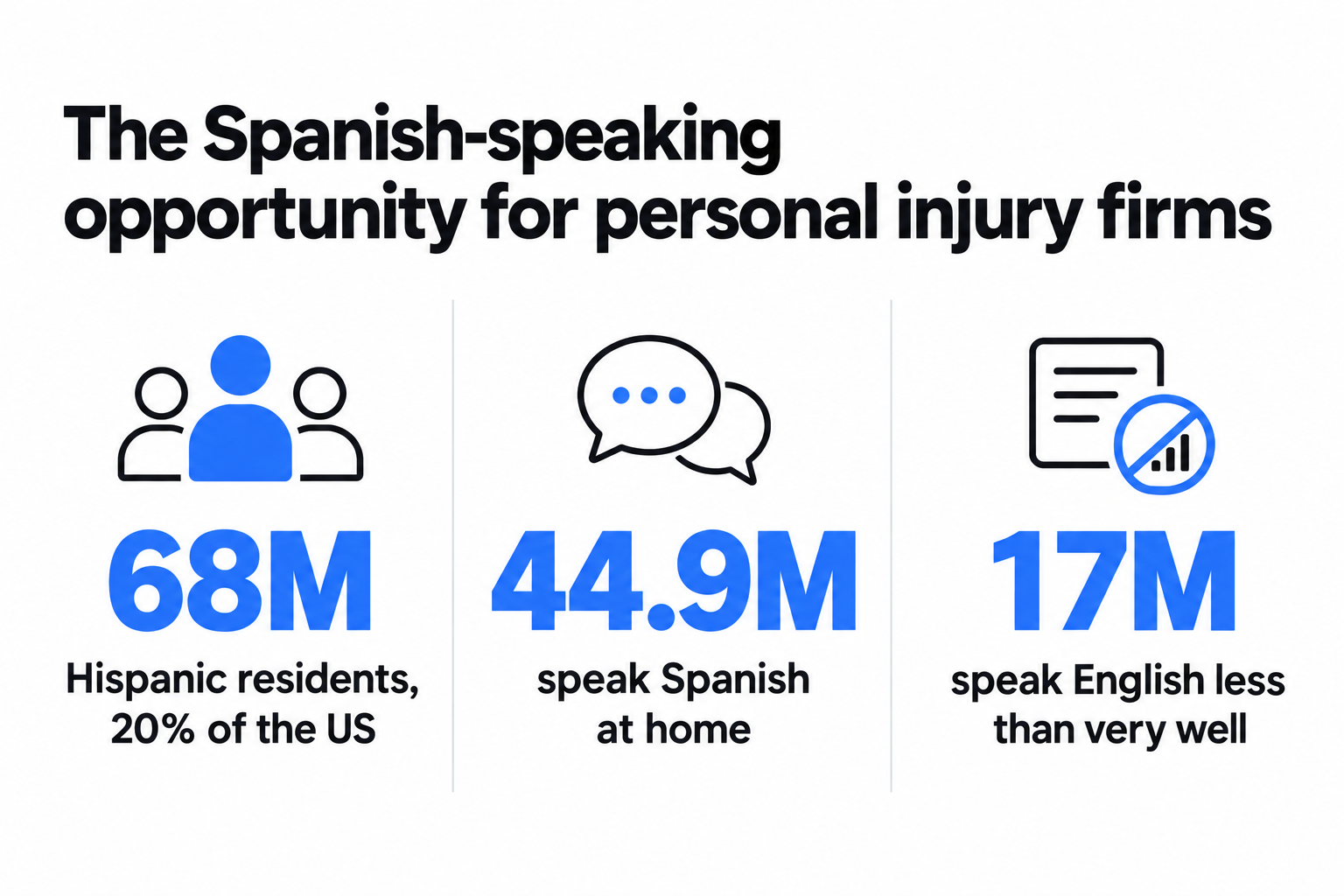
As of July 2024, the Hispanic population of the United States was about 68 million people, roughly 20% of the whole country, according to the Census Bureau's 2024 population estimates. That share crossed 20% for the first time that year, and it grew 2.9% in a single year while the rest of the population barely moved.
Language is the part that matters for intake. About 44.9 million people speak Spanish at home, close to 1 in 7 people age 5 and older, per the 2024 American Community Survey. Spanish is the most common non-English language in the country by a wide margin.
Now the number that should keep you up at night. Around 27 million US residents speak English less than "very well," and roughly 17 million of them are Spanish speakers, based on the Census Bureau's 2020 to 2024 American Community Survey. These are people who can describe a crash, a fall, or a dog bite clearly in Spanish and struggle to do it in English. When your intake only works in English, you are not screening them out on the merits. You are screening them out on language.
Personal injury is exactly where this hurts most. Spanish-speaking clients in personal injury cases are often working jobs with higher injury rates, they are hit hard by a lost paycheck, and they are frequently told by everyone around them that "the system" is not for them. The firm that greets them in their own language at minute one earns a trust the billboard down the street never will.
English-only intake quietly bleeds cases day and night
Two forces stack here, and together they are brutal.
The first is speed. Injured people shop fast and move on faster. An analysis of roughly 3.5 million leads found that answering within the first minute, rather than later, can lift conversion by nearly 391% (Velocify), and the average business takes about 42 hours to reply to an online inquiry (Harvard Business Review). A lead that sits in an inbox overnight is usually gone by breakfast.
The second is language. Put a language wall on top of a speed problem and you do not add two leaks, you multiply them. A Spanish-speaking claimant who hits an English form after hours has two reasons to leave instead of one. Most will not fill out a form in a language they are unsure of, and most will not wait until morning to find out if anyone at your office speaks Spanish.
Here is the part firms miss. You never see these losses. There is no missed-call log for a website visitor who read your English form and left. The case simply shows up at a competitor, and your reports look normal. The leak is invisible, which is exactly why it keeps running.
A bilingual legal answering service fixes the phone, not the website
Plenty of firms search for a bilingual legal answering service, and that makes sense. A good one puts a Spanish-speaking human on the phone so a caller is not stuck with English-only hold music.
But look at how injured people actually reach you in 2027. A huge share arrive first on your website, often from a phone, late at night, after they have already clicked past three other firms. Many would rather text than talk. A phone answering service does nothing for the visitor who is standing on your website at 11pm reading an English form. It was never built for that moment.
So the question is not only "who answers my phones in Spanish." It is "what happens when a Spanish-speaking injured person lands on my website or sends a text, right now, and no human is awake." If the answer is "an English form" or "nothing," that is the case you are losing.
What real bilingual intake requires in 2027
Real bilingual intake is not a checkbox. It is a short list of things that have to be true.
- It runs the full intake in Spanish, not a form with Spanish labels. The claimant should be able to explain the whole incident in Spanish and get answers in Spanish.
- It works the second they arrive, on the website and by text message, any hour, any day. Speed is the entire game.
- It captures evidence early. Photos of the injury, the vehicle, the scene, a short video. Strong facts gathered at minute one make the case easier to value later.
- It hands off to a real person cleanly. When a human on your team is ready, they should be able to step in without the claimant repeating their story.
- It treats English and Spanish as equals, not a main version and an afterthought.
Tools for this now exist. AI intake built for personal injury firms can meet a Spanish-speaking visitor the moment they reach your site and carry the conversation in their language. Burt is one option. It runs the full intake in Spanish automatically by chat and by text the instant someone lands on your website, 24/7, and captures photos and video as the person describes what happened, so the case is documented before anyone on your team is awake. It handles the website and text side, not phone calls, so most firms pair it with their existing phone coverage. You can see how it looks on your own site here.
The point is not the specific tool. The point is that "we have a Spanish-speaking receptionist during business hours" is no longer a complete answer. Injuries and after-hours searches do not keep office hours.
How to start without rebuilding your whole practice
You do not need a second firm to serve Spanish-speaking claimants well. Start where the leak is biggest.
Watch your own website first. Open it on a phone, in Spanish, after hours, and go through what a hurt person actually sees. If the only option is an English form, you have found money on the floor. Fix the first touch before you touch anything else, because the first touch is where the case is won or lost. Growth from here is less about spending more and more about keeping the leads you already earn, which is the same lesson behind how to grow a personal injury firm in general: stop the leaks before you turn up the faucet.
Frequently asked questions
Is the Spanish-speaking market really big enough to justify bilingual intake? Yes. About 44.9 million people speak Spanish at home in the US as of the 2024 American Community Survey, and roughly 17 million are Spanish speakers who report speaking English less than "very well." For a practice that lives on volume of qualified claimants, that is one of the largest underserved pools of cases in the country.
What is the difference between a bilingual answering service and bilingual intake? An answering service mostly handles phone calls with a Spanish-speaking person. Bilingual intake covers every way an injured person reaches you, including your website and texts, and carries the full conversation in Spanish the moment they arrive, even at 2am. The phone is one door. In 2027 your website and texts are busier doors, and usually no one is standing at them after hours.
Can I just use Google Translate or a translated form? A translated form still forces the claimant to do the hard part in English, and answers none of their questions. Real bilingual intake holds a two-way conversation in Spanish, asks the follow-up questions a trained intake person would, and gathers the facts and evidence you need to value the case.
Will bilingual intake replace my staff? No. The goal is that no Spanish-speaking case slips away before your team can reach it, especially nights and weekends. The best setup answers instantly in Spanish, captures the facts and photos, then hands a warm, documented case to a real person on your team instead of losing it to the firm across town.
You cannot win a case you never heard about. Every week your intake works in English only, Spanish-speaking injured people are finding you, hitting a wall, and signing somewhere else. Closing that one leak is often the cheapest growth a personal injury firm can buy.
Subscribe for plain, practical breakdowns like this on turning more injured callers, clickers, and texters into signed personal injury cases.