A hurt person finds your firm at 9pm on a Sunday. They are scared, in pain, and ready to talk. Your office is closed. The call goes to voicemail, or the website form sits in an inbox until Monday. By then they have already called the next three firms on the list, and one of them picked up.
That lost case is the problem an AI receptionist for law firms is sold to solve. The pitch is simple: something answers every inquiry, day or night, so no hurt person gets a dial tone. But the label covers very different tools, and a few of them do not do what the name suggests. This guide sorts out the categories so you can pick the one that fits how injured people actually reach your firm in 2027.
The name hides four very different things
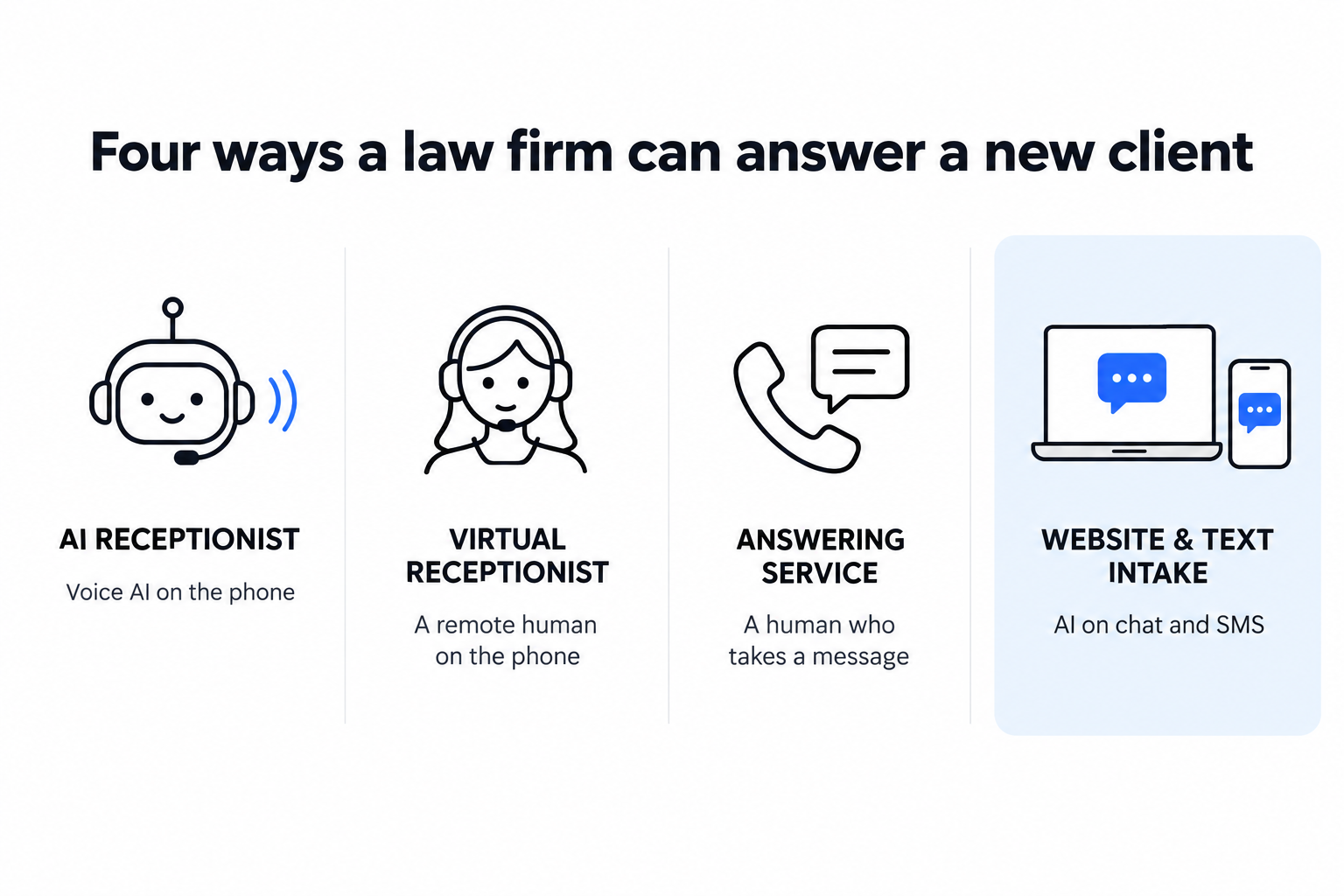
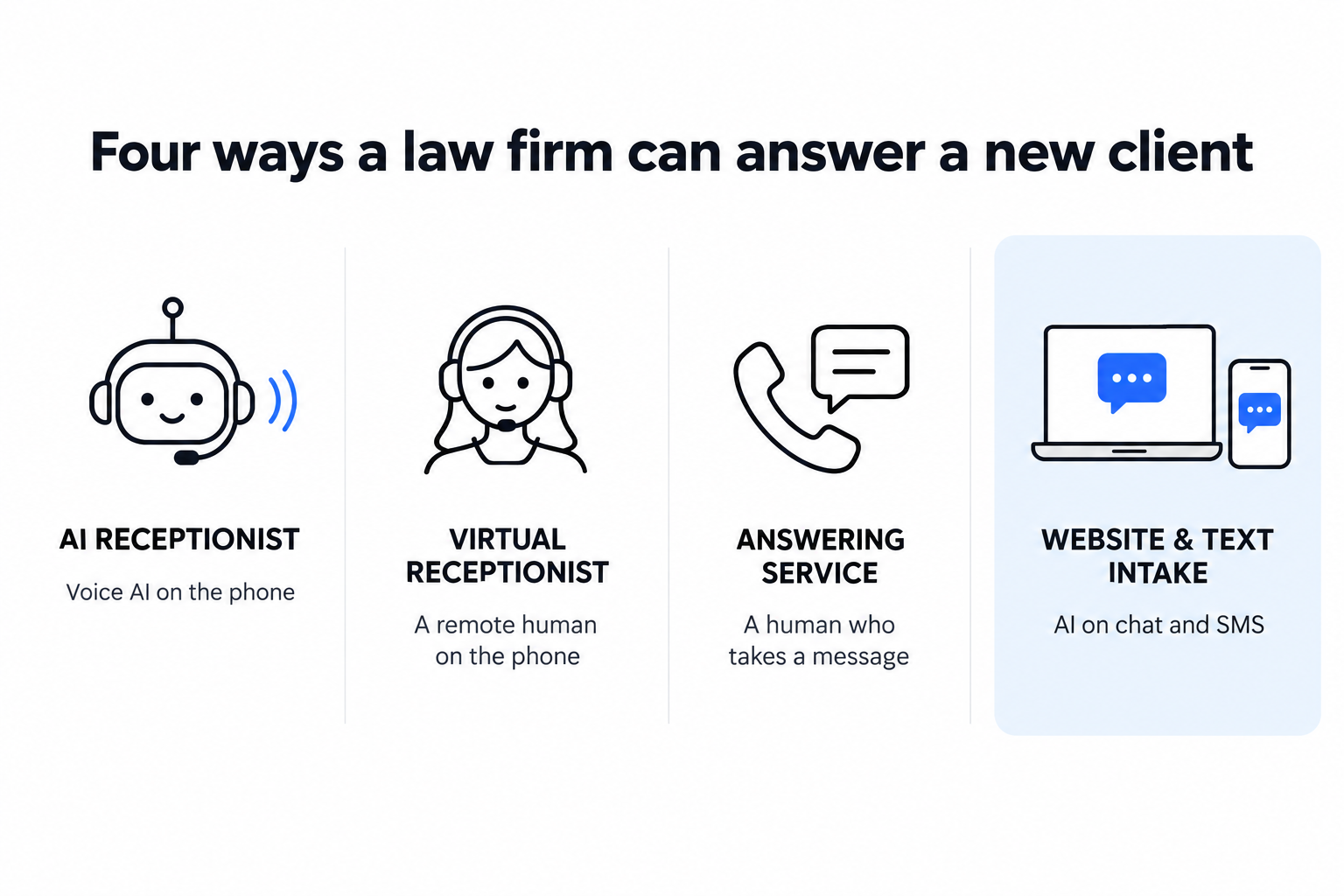
"AI receptionist" gets used loosely. In practice you are choosing among four models, and they answer different doors.
An AI receptionist is usually a voice system. It answers the phone, runs an intake script, screens for case type, and books a consultation onto your calendar, all without a person on the line. Vendors report that most calls get handled start to finish, with the rest routed to staff with a summary.
A virtual receptionist for law firms is a trained human working remotely. They answer your calls, do real intake, schedule consultations, and often log everything into your case software. They sound like part of your team.
An answering service is also human, but built to capture and relay. Operators follow a short script, take a message, and pass it on. Many of them handle calls for hundreds of businesses at once.
Website and text intake answers a different door entirely. Instead of the phone, it responds to the people who land on your site or text you, by chat and SMS, around the clock. This is the category Burt sits in, and it is worth separating out, because most of your paid traffic and after-hours inquiries arrive as a click, not a call.
A side-by-side comparison
| AI receptionist | Virtual receptionist | Answering service | Website / text intake | |
|---|---|---|---|---|
| Who answers | Voice AI | Trained human, remote | Human operator | Chat/SMS AI, human takeover |
| Channel | Phone calls | Phone calls | Phone calls | Your website and text |
| What it does | Script, screen, book | Full intake, scheduling | Take and relay messages | Qualify, capture evidence, hand off |
| Available 24/7 | Yes | Often, for a fee | Yes | Yes |
| Typical cost | ~$99 to $299/mo | ~$240 to $300+/mo | $1.50 to $5/min, or ~$20 to $50 per intake | Varies by vendor |
| Best for | High call volume | A premium phone feel | Simple message-taking | Web and after-hours leads |
Costs here come from published 2026 vendor pricing. Human services run higher because a person is on every call. Smith.ai, which sells both, lists 30 calls at $292.50 a month with a human virtual receptionist and $97.50 for the same volume with its AI, a gap that shows the labor difference plainly.
Why speed is the whole game
The reason any of this matters is response time, and the research on it is blunt.
A study of nearly 3.5 million leads found that calling within one minute lifts conversion by 391% over slower follow-up. Separate work from MIT and the Harvard Business Review found that contacting a web lead within five minutes makes you up to 21 times more likely to qualify it than waiting just 30 minutes. Across industries, roughly half of all sales go to whoever responds first.
Now look at the real-world number those same studies report: the median response time across the companies measured was 42 hours. For a PI firm, 42 hours is three competitors and a signed retainer somewhere else. The tool matters far less than this: does someone respond in the first minute, every time, on every channel your clients use?
How a PI firm should actually choose
Start with where your leads come from, not with the technology.
If most injured people call you, a phone-based AI receptionist or a human virtual receptionist is the obvious fit. Pick AI if volume is high and your questions are standard. Pick a human if a warm voice is part of how you win, and you can carry the cost.
If a large share of your inquiries arrive through your website, paid ads, or text, a phone tool does nothing for them. A visitor who clicks your ad at midnight will not call. They will type, or they will leave. That is the case for website and text intake, and it is why we treat it as its own category rather than folding it into "receptionist."
One honest note, since the labels blur: Burt answers your website and text channels, not your phone. It qualifies the person in English or Spanish, can capture photos and video of the injury during the chat, and hands off to your team when a human should step in. It does not make or answer phone calls. If your phones are the gap, you want a voice tool. If your website quietly drops after-hours leads, that is the door Burt was built for. Many firms end up running one of each.
For the full picture of how web intake qualifies a case, see our guide to AI intake for personal injury firms. And if you are weighing a bot against a live phone team, our breakdown of AI intake versus an answering service goes deeper on the tradeoffs.
What to check before you sign anything
A few questions separate a real tool from a demo that falls apart in week two:
- Does it cover the channel your leads actually use, phone or web or both?
- Can a human take over a conversation when the case needs judgment?
- Does it hand your staff a clean summary, or just a raw transcript?
- Does it work in Spanish if your market has Spanish-speaking claimants?
- What happens to a lead it cannot handle? It should route, not drop.
Frequently asked questions
Is an AI receptionist the same as a virtual receptionist? No. A virtual receptionist for law firms is a trained human working remotely who answers your calls and does intake. An AI receptionist is software that answers calls automatically. They overlap in purpose, but one is a person and one is a program, and that difference shows up in both cost and feel.
Can an AI receptionist answer my firm's website and text messages? Most cannot. The majority of products marketed as AI receptionists are built for phone calls. Answering website chat and SMS is a separate category of tool. If after-hours web leads are your leak, confirm the vendor actually covers those channels before you buy, because the name alone will not tell you.
What is the best virtual receptionist for law firms? There is no single best one. The right choice depends on your call volume, your budget, and whether you want a human voice or automated handling. Shortlist two or three, run the same intake script through each, and judge them on response speed and how clean the handoff to your staff is.
Does an AI receptionist give legal advice? A properly built one does not. It handles intake, screening, and scheduling, then routes anything that needs a lawyer's judgment to your team. Treat any tool that offers to answer legal questions as a liability, not a feature.
The right intake setup is not about buying the newest AI. It is about making sure a scared person who reaches out at midnight gets an answer before they reach the next firm. Figure out which doors your leads come through, then cover those doors with something that responds in the first minute.
We write one plain-English guide like this for personal injury firm owners each week, on intake, speed-to-lead, and growing a practice without the jargon.
Subscribe to get the next one in your inbox, free, no sales pitch.